PRACTICE UPDATE: How the content must now be read in light of current ImmD policy:
Historical Context: Phased Staging and Pragmatic Chronologies
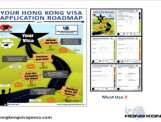
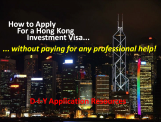
Historically, as examined in 3 – How to Apply For a Hong Kong Investment Visa Without Any Professional Help – Order of Business, this installment of the Centre O presentation series established the sequential workflow for self-directed applicants preparing an Investment as Entrepreneur application under the General Employment Policy (GEP). The Geeza mapped out a pragmatic, risk-mitigated chronological roadmap: incorporating the Hong Kong corporate entity, setting up local bank accounts, securing a flexible serviced office or co-working space, compiling a comprehensive narrative business plan, and submitting the dossier while residing on visitor status. Under the prevailing discretionary regime, this sequence allowed founders to conserve capital and avoid irreversible overhead before securing official clearance. An applicant did not need a fully operational business machine running on day one; case officers comfortably approved lean, bootstrapped operations backed by modest seed capital of a few hundred thousand Hong Kong dollars, a shared desk, and a forward-looking plan projecting phased local hiring over a two- to three-year ramp-up period.
Modern Reality: The Total Inversion of Procedural Sequencing by the Hardware Audit
As detailed in A Major Strategic Shift: The Upgraded Assessment Regime for Hong Kong’s Investment as Entrepreneur Visa, the chronological sequencing of an entrepreneur filing has been fundamentally upended and replaced with a binary compliance audit. Under post-April 2026 administrative practice aligned with Top Talent Pass Scheme (TTPS) Category A operational substance, benchmarked at an enterprise scale of approximately HKD 2.5 million, ImmD no longer permits a “plan first, deploy later” sequence. Case officers completely disregard forward-looking timelines and narrative projections. For un-incubated applicants, the required order of business mandates that enterprise-grade corporate hardware be completely established, capitalized, and commercially operational before submitting the visa dossier: HKD 1.5 million to HKD 2.0 million in dedicated corporate liquidity deployed in a local Hong Kong business bank account; an executed commercial tenancy agreement for exclusive physical premises (four walls), strictly disqualifying serviced offices, virtual addresses, shared desks, and co-working spaces; and active Mandatory Provident Fund (MPF) payroll contributions for two to three full-time local Hong Kong permanent resident employees working on-site from inception.
Strategic Baseline: The Trap of Phased Commitment vs. The Incubator Monopoly
Consequently, following the historical “order of business” by staging commitments conservatively is an administrative death trap for modern founders. An un-incubated applicant who executes incorporation, rents a co-working space, deposits modest seed funds, and applies on the premise that capital deployment and hiring will follow upon visa approval will face swift and summary refusal. This instant rejection terminates lawful visitor stay, prompts an abrupt exit from the territory, and permanently breaks the applicant’s continuous ordinary residence chain required to secure Right of Abode under the seven-year rule. The modern business entry framework enforces an absolute institutional monopoly: formal, documented admission into an officially accredited government incubation program, such as Cyberport, the Hong Kong Science and Technology Parks Corporation (HKSTP), or the Design Incubation Programme, serves as the sole surviving statutory mechanism recognized by ImmD to waive the mandatory upfront liquidity, dedicated commercial lease, and immediate MPF headcount thresholds. Outside this accredited institutional safe harbor, following a phased, low-risk sequence is impossible; founders must bear catastrophic upfront capital exposure on day one or face guaranteed refusal.
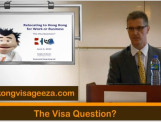
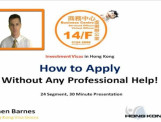
The 30 minute talk was broken down into 24 very easy to digest segments and each of these segments is presented here.
The talk is designed to allow the D-I-Y visa applicant to use the 100% free resources of both the Hong Kong Visa Handbook as well as the Hong Kong Visa Geeza Blog.
The Hong Kong Visa Geeza (a.k.a Stephen Barnes) is a co-founder of the Hong Kong Visa Centre and author of the Hong Kong Visa Handbook. A law graduate of the London School of Economics, Stephen has been practicing Hong Kong immigration since 1993 and is widely acknowledged as the leading authority on business immigration matters here for the last 24 years.