Hong Kong Visas Made Easy

14

Oct 2026

PRACTICE UPDATE: Navigating The New Capital Investment Entrant Scheme

Posted by / in Investment Visas, Musing, Practice Update, Special Programmes, VG Front Page / No responses

 Navigating The New Capital Investment Entrant Scheme (New CIES)

Regulatory Architecture, Portfolio Rules, and Operational Realities
Over the past three and a half decades of advising on Hong Kong immigration law, jurisprudence, and administrative practice, our firm has observed numerous regulatory cycles, administrative refinements, and policy calibrations. Across that thirty-five-year continuum, the Immigration Department (ImmD) has routinely adjusted its assessment metrics to match broader macro-economic priorities.

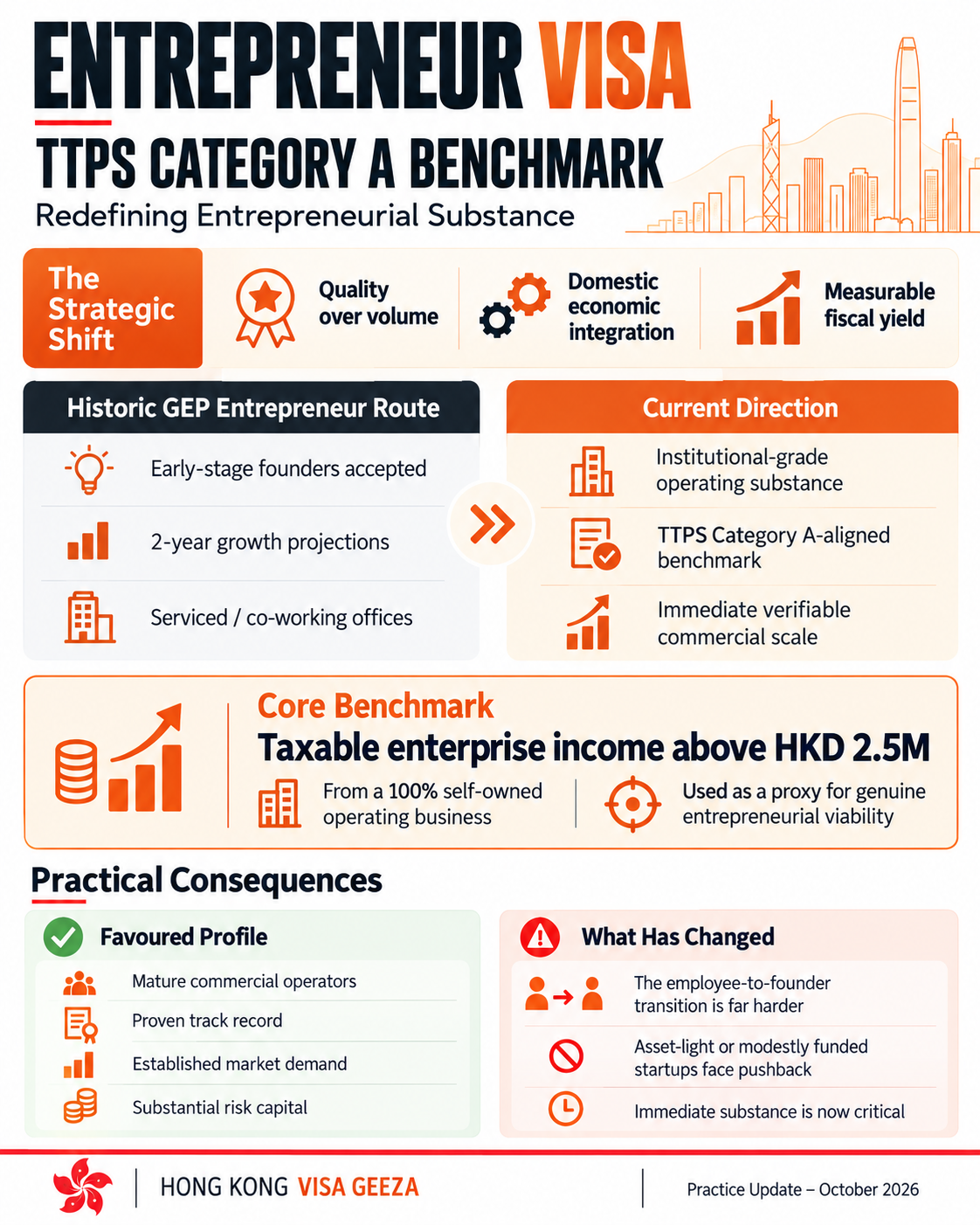
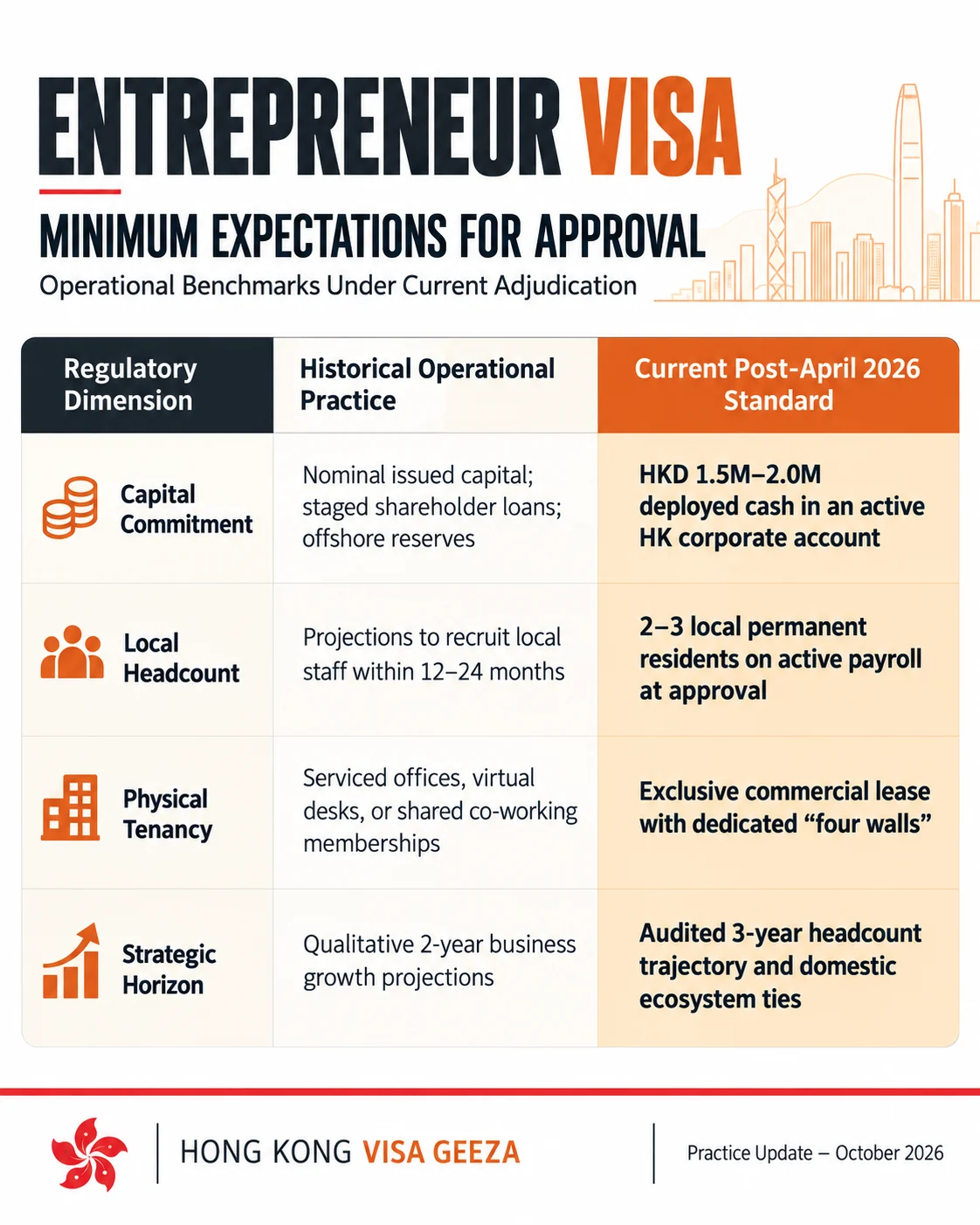
However, the modern immigration landscape has entered an entirely new phase of regulatory deliberate differentiation. On one flank, the Top Talent Pass Scheme (TTPS) has evolved from an aggressive, fast-track credential attraction exercise into an exacting renewal regime demanding genuine local economic participation, active employment, or verifiable corporate trading. On the other flank, the General Employment Policy (GEP) – Investment as Entrepreneur channel has fundamentally hardened, closing the door on asset-light, early-stage lifestyle startups and demanding institutional-grade operational footprints—characterized by HKD 1.5 million to HKD 2.0 million in deployed cash, exclusive commercial tenancy (“four walls”), and immediate local payroll commitments.

Standing in sharp structural contrast to both of these active-involvement regimes is the New Capital Investment Entrant Scheme (New CIES).

Navigating The New Capital Investment Entrant Scheme: Relaunched to position the Hong Kong Special Administrative Region (HKSAR) as the pre-eminent family office and wealth management hub in the Asia-Pacific region, the New CIES departs entirely from the operational, employment, and commercial demands of active visas. It offers an unconstrained, passive residency gateway for high-net-worth individuals (HNWIs) and their families. Yet, while the scheme eliminates the operational friction of running a business or maintaining a local employment relationship, it introduces an intricate, bifurcated compliance apparatus governed jointly by the New CIES Office of InvestHK and the Immigration Department.

Navigating this framework requires an exact appreciation of financial eligibility criteria, portfolio ring-fencing, permissible investment classes, ongoing intermediary maintenance, and the distinct mechanics governing the eventual transition to permanent status. This Practice Direction sets out the definitive operational, legal, and procedural guidance for prospective applicants, private bankers, family office practitioners, and professional advisers.

For procedural workflows, document checklists, and application logistics, practitioners should cross-reference the Hong Kong Visa Handbook and consult advisory counsel via the Hong Kong Visa Centre.

Statutory Foundations and Bifurcated Institutional Architecture

The fundamental administrative hallmark of the New CIES is that it does not operate as a single-door immigration assessment. Traditional visas—such as the GEP, ASMTP, or TTPS—are evaluated solely by immigration officers within the specialized divisions of the Immigration Department. The New CIES, by contrast, splits statutory jurisdiction across two distinct government entities:

Statutory and administrative policy materials governing these processes are detailed through the official InvestHK New CIES Portal and the administrative criteria published by the Hong Kong Immigration Department.
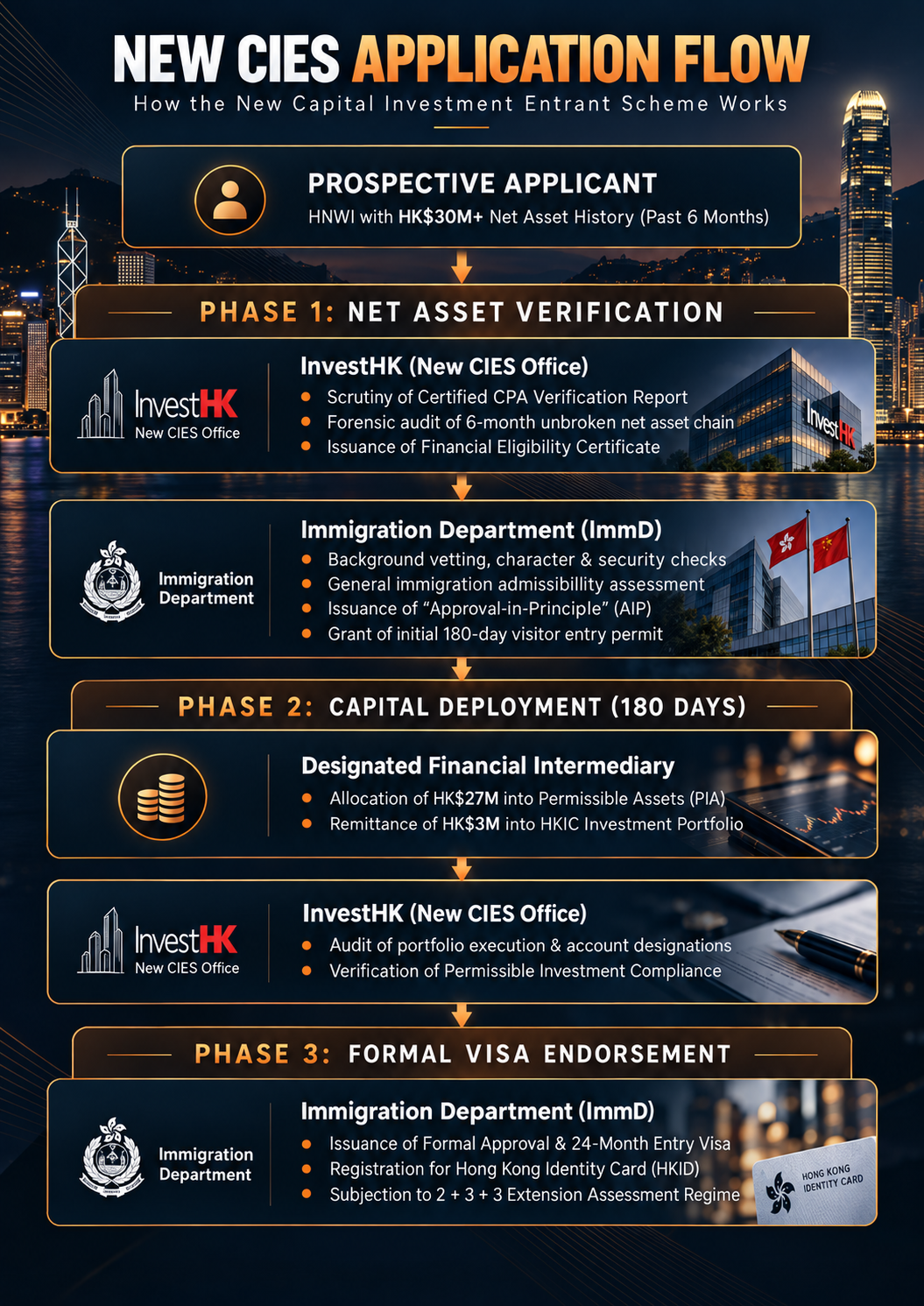
Explains how the NICES process flow works in Hong Kong Immigration

Institutional Division of Labour

The New CIES Office of InvestHK: Acts as the financial gatekeeper. InvestHK is exclusively empowered to assess, verify, and monitor the financial criteria. This includes scrutinizing the applicant’s historical net asset position, determining whether prospective assets fall within permissible statutory classes, and conducting annual portfolio audits to ensure continuous compliance.

The Immigration Department (ImmD): Retains exclusive sovereign authority under the Immigration Ordinance (Cap. 115) over entry clearance, security screening, character assessment, the grant of formal visas, extensions of stay, and the eventual adjudication of applications for the Right of Abode or Unconditional Stay.

This administrative bifurcation means that an applicant cannot rely on immigration arguments to cure a financial portfolio deficiency, nor can a robust investment portfolio compel the Immigration Department to overlook adverse character or immigration compliance histories. Both administrative arms must be satisfied independently at every statutory milestone.

Core Eligibility Criteria & The Two-Year Net Asset Assessment

To secure entry under the New CIES, a prospective applicant must satisfy clear baseline criteria regarding nationality, age, and historical personal wealth.

Eligible Categories of Applicants

In alignment with Hong Kong’s overarching immigration policy and constitutional framework (and subject to the statutory nationality exclusions and general entry prerequisites published by ImmD), the New CIES is accessible to:

  1. Foreign nationals (holding foreign passports and possessing valid travel documentation);
  2. Macao Special Administrative Region (SAR) residents;
  3. Chinese nationals who have obtained permanent resident status in a foreign country; and
  4. Taiwan residents.

Practice Note for Mainland Chinese Nationals: Chinese nationals residing in Mainland China who do not possess foreign nationality are not eligible to apply directly under the New CIES. However, following established long-term administrative practice, Chinese nationals who hold third-country permanent resident status (e.g., permanent resident status acquired in a foreign jurisdiction) qualify under the scheme. Ensuring that third-country permanent residency documentation is fully verified, authentic, and recognized by ImmD is an essential preliminary step.

The HK$30,000,000 Net Asset Threshold

The applicant must demonstrate to the absolute satisfaction of the New CIES Office that they have been the sole legal and beneficial owner of net assets of not less than HK$30 million (or its equivalent in foreign currencies) continuously throughout the 6months immediately preceding the date of application.

This requirement is subject to rigorous evidentiary standards:

The Continuous 6-Month Ownership Rule: The statutory requirement is not satisfied by simply demonstrating HK$30 million on the date of application. The equity must have been under the continuous ownership and control of the applicant for every single day of the preceding 6-month period. Any dip below the HK$30 million valuation mark during the lookback period breaks the continuous chain and resets the statutory clock.

Sole Beneficial Ownership: The qualifying assets must belong to the applicant personally. Assets owned jointly with individuals other than the applicant require strict accounting: only the portion of net equity attributable directly and exclusively to the applicant can be counted. Where assets are held through private holding vehicles, the applicant must hold 100% of the beneficial ownership of that entity.

Independent Certified Public Accountant (CPA) Audit: Applicants are required to engage, at their own cost, a Certified Public Accountant (Practicing) who is an active member of the Hong Kong Institute of Certified Public Accountants (HKICPA). The CPA must conduct an independent audit of the applicant’s worldwide asset portfolio, verify ownership documents, review asset encumbrances, and issue an official CPA Verification Report on Net Assets.

Qualifying Asset Classes for Net Asset Verification

When computing historical net worth for the Phase 1 assessment, the CPA and InvestHK may evaluate a broad spectrum of global assets, provided they are unencumbered and supported by verifiable legal title:

Bank Deposits: Liquid savings and fixed-term cash deposits held with licensed domestic or overseas financial institutions.

Public Equities & Listed Debt: Shares, corporate bonds, government notes, and structured securities traded on recognized international exchanges, valued on market close.

Real Estate Equity: Residential, commercial, retail, or industrial real estate held worldwide. Valuations must be established by independent professional valuation reports prepared by qualified property surveyors, deducting all registered mortgages, legal charges, and commercial encumbrances.

Interests in Private Companies: Equity holdings in operating or private holding companies, provided valuation is substantiated by audited financial statements and formal share registers.

The Permissible Investment Architecture: Allocating the HK$30 Million

Once the New CIES Office approves the net asset assessment and ImmD grants Approval-in-Principle, the applicant is required to formally deploy the mandatory HK$30 million into qualifying Hong Kong investments. This deployment must occur within 180 days after Approval-in-Principle is granted (or within 180 days prior to the date of submitting the formal net asset assessment to InvestHK).

The statutory architecture establishes a strict HK$27 million / HK$3 million structural split:
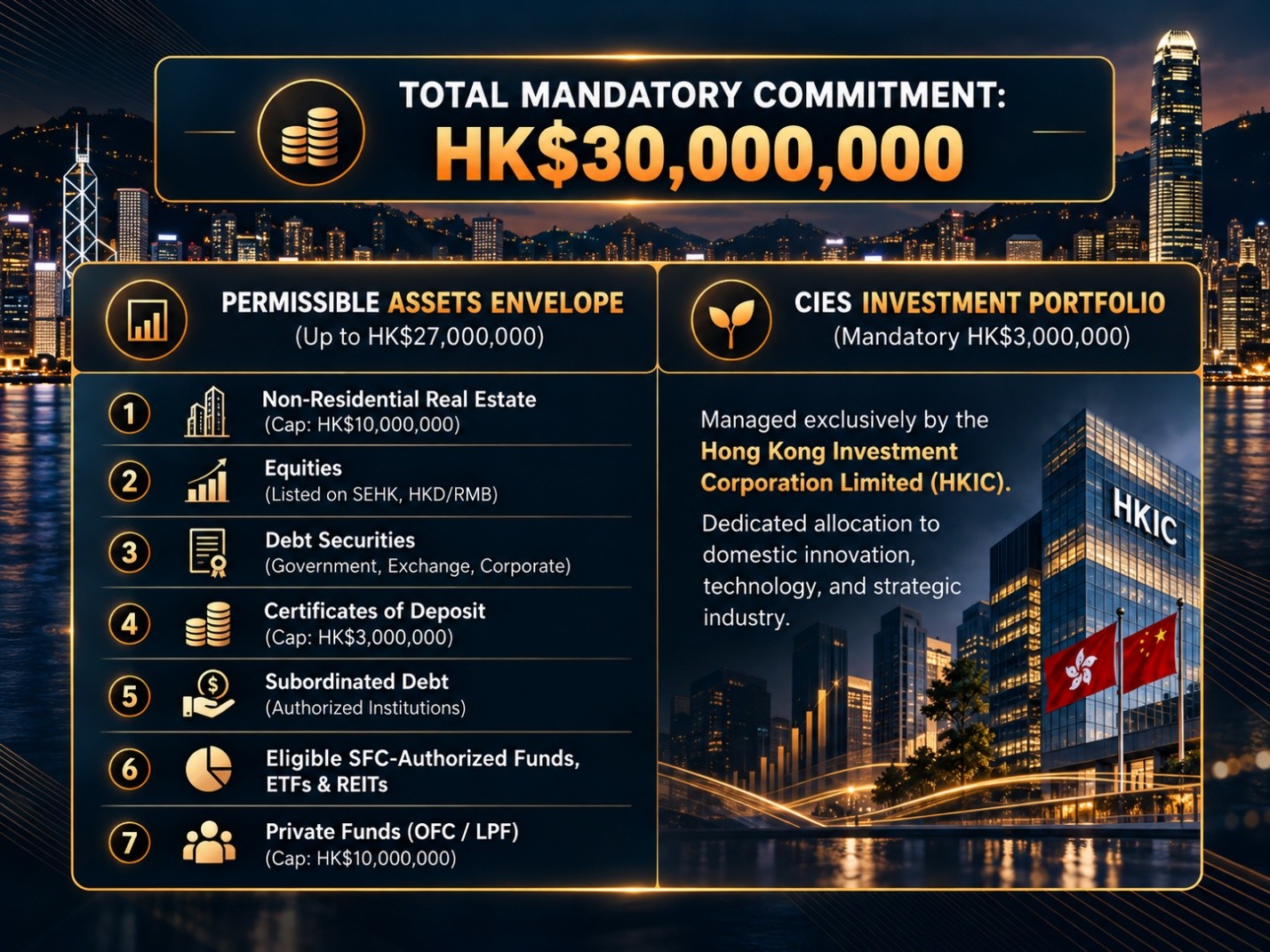
The HK$27 Million Permissible Assets Envelope

Applicants enjoy flexibility in managing and allocating up to HK$27 million across approved financial instruments and commercial property classes:

Non-Residential Real Estate (Subject to a HK$10 Million Sub-Cap)

Permissible Holdings: Commercial properties, industrial premises, retail spaces, warehouses, and dedicated office buildings situated in Hong Kong. Pre-completion non-residential commercial properties are also eligible.

Strict Residential Exclusion: Pure residential properties (apartments, residential houses, serviced residential suites) are strictly excluded from qualifying under the scheme.

Valuation & Cap Rules: An applicant may acquire non-residential property of any purchase price; however, a statutory maximum of HK$10 million can be counted toward the required HK$27 million allocation. Any amount invested above HK$10 million is ignored for the purposes of the CIES capital tally.

Permissible Financial Assets

Financial assets must be denominated in Hong Kong Dollars (HKD) or Renminbi (RMB) and acquired through a designated intermediary:

Equities: Shares of companies listed on the Main Board or GEM of the Stock Exchange of Hong Kong (SEHK).

Debt Securities: Fixed or floating-rate debt securities, bonds, and notes listed on SEHK; debt issued or guaranteed by the HKSAR Government, the Exchange Fund, the Hong Kong Mortgage Corporation, or other designated statutory bodies; and debt instruments listed on SEHK issued by authorized institutions.

Certificates of Deposit (CDs): Issued by Authorized Institutions under the Banking Ordinance, with a remaining term to maturity of not less than 12 months at the time of purchase. An aggregate statutory cap of HK$3 million applies to Certificates of Deposit.

Subordinated Debt: Subordinated instruments issued by Authorized Institutions under applicable regulatory frameworks.

Eligible Collective Investment Schemes (CIS): Securities and Futures Commission (SFC)-authorized unit trusts, mutual funds, exchange-traded funds (ETFs), and authorized Real Estate Investment Trusts (REITs).

Private Fund Structures (Subject to a HK$10 Million Sub-Cap): Ownership interests in registered private Open-ended Fund Companies (OFCs) or private Limited Partnership Funds (LPFs) established under Hong Kong law, distributed or managed by licensed corporations. An aggregate ceiling of HK$10 million applies to investments across private funds.

The Mandatory HK$3 Million Ring-Fence: The CIES Investment Portfolio

A distinctive innovation of the New CIES is the mandatory ring-fencing of HK$3 million into the dedicated CIES Investment Portfolio.

Institutional Management: This capital pool is managed and administered directly by the Hong Kong Investment Corporation Limited (HKIC).

Strategic Deployment: The capital is pooled into public-interest investments intended to support the development of local innovation and technology, semiconductor fabrication, artificial intelligence infrastructure, life sciences, green transition initiatives, and strategic industrial projects aligned with Hong Kong’s Five-Year Plan and Greater Bay Area economic integration.

Investor Rights: Entrants hold a beneficial claim to their underlying share of the portfolio but exercise no individual management discretion or trading authority over asset selection. Capital distributions, realization proceeds, or liquidation dividends are administered centrally in accordance with rules set down by the HKIC upon portfolio realization or the entrant’s exit from the scheme.

The Permissible Investment Account (PIA) and Intermediary Protocols

Compliance with the New CIES does not merely involve purchasing eligible assets; it dictates the precise custodial and institutional framework through which those assets must be held, reported, and managed.

Eligible Financial Intermediaries

All permissible financial assets comprising the HK$27 million portfolio must be held in a dedicated, segregated account known as a Permissible Investment Account (PIA), opened in the applicant’s sole name with an Eligible Financial Intermediary. Eligible intermediaries fall into three statutory classifications:

An Authorized Institution (AI) licensed under the Banking Ordinance (Cap. 155) (e.g., licensed banks, restricted licence banks);

A Licensed Corporation (LC) licensed under the Securities and Futures Ordinance (Cap. 571) to conduct Type 1 (Dealing in Securities), Type 4 (Advising on Securities), or Type 9 (Asset Management) regulated activities; or

An Authorized Insurer under the Insurance Authority licensed to issue Class C (Investment-Linked Assurance Scheme) policies.

An applicant may appoint up to three separate financial intermediaries to manage different tranches of their financial portfolio, but each intermediary must maintain an isolated PIA explicitly tagged to the entrant’s CIES reference.

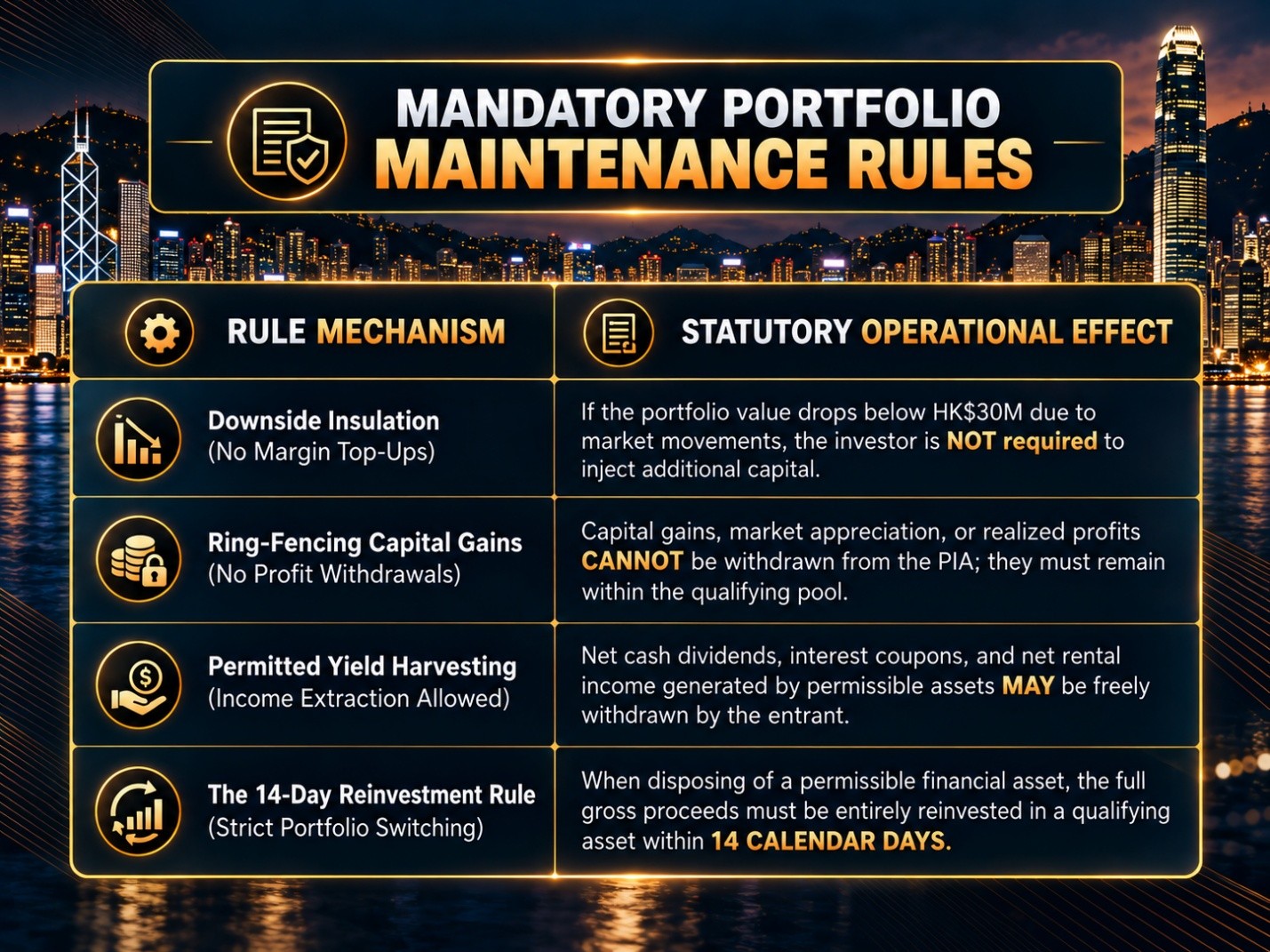
Mandatory Portfolio Maintenance Rules

The 14-day switching window requires constant vigilance. If an equity holding or corporate bond within the PIA is liquidated, the gross proceeds cannot sit as uninvested cash in a settlement account indefinitely. If replacement qualifying assets are not acquired within 14 calendar days, the investor falls into technical non-compliance. Financial intermediaries are mandated under statutory reporting covenants to notify InvestHK of any uncorrected breach.

Furthermore, pledging, charging, mortgaging, or assigning the permissible assets inside the PIA as collateral or security for personal loans, margin credit lines, or commercial borrowing is strictly prohibited. Any encumbrance invalidates the asset’s qualifying status.
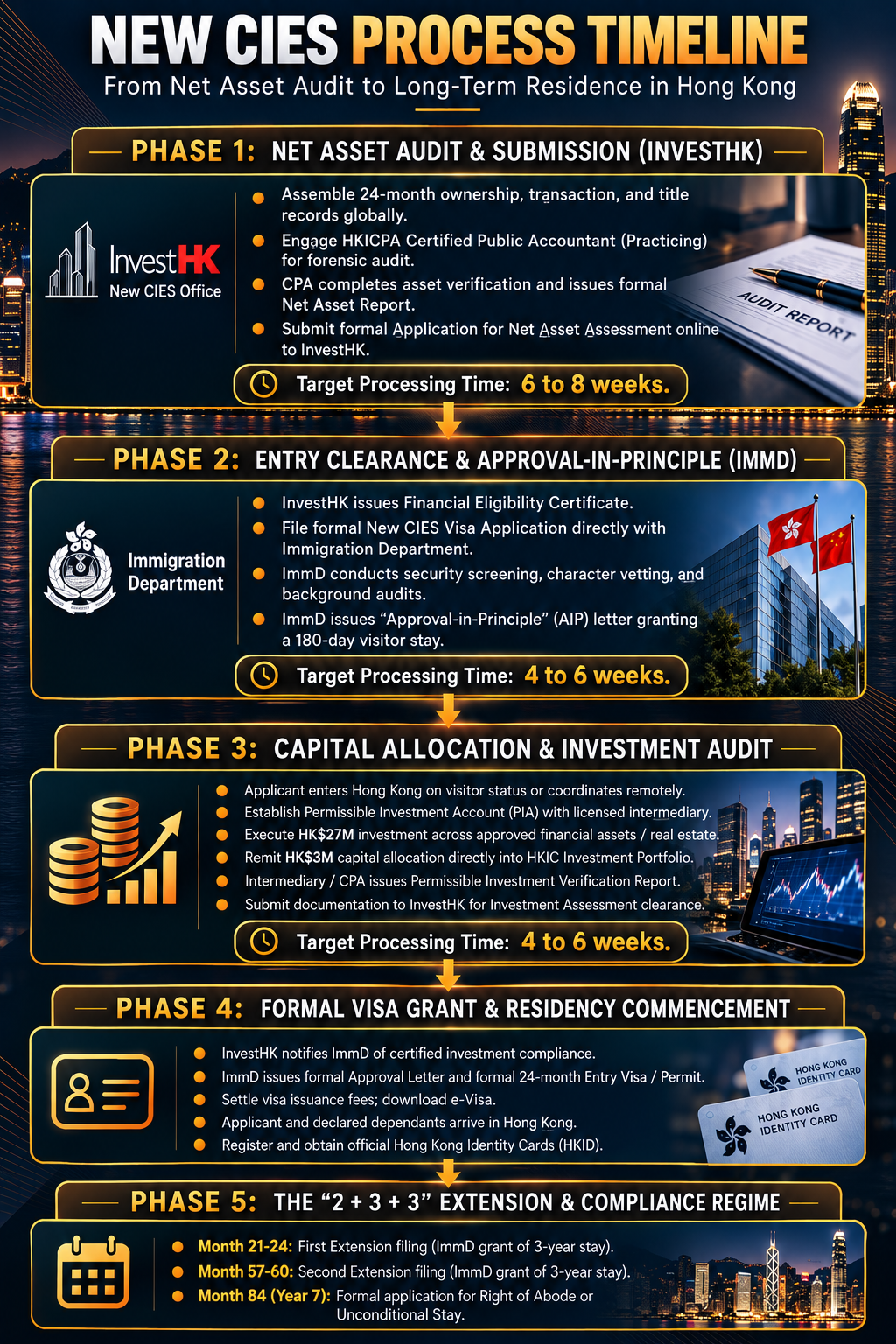
Procedural Roadmap: Phase-by-Phase Application Lifecycle

Navigating a New CIES application involves executing five distinct operational phases over a multi-month timeline. The process requires precise, synchronized filings between the legal team, the auditing CPA, the financial intermediary, InvestHK, and ImmD.
Dependant Entitlements

The primary applicant is entitled to sponsor immediate family members under formal Dependant Visa status:

Spouse: Lawfully married under recognized civil marriage statutes, or a party to a recognized same-sex civil partnership/union.

Children: Unmarried, dependent children under the age of 18 at the time of adjudication.

Dependants under the New CIES enjoy comprehensive rights in Hong Kong. Unlike dependant regimes in certain foreign jurisdictions, dependants of New CIES entrants are permitted to take up lawful employment, engage in business entrepreneurship, or pursue studies in local public institutions, private international schools, and universities without requiring prior permission or independent sponsorship from the Immigration Department.

Extension of Stay Regime: The “2 + 3 + 3” Cycle and Annual Compliance

The initial entry permission granted to a New CIES entrant is valid for 24 months. Continued lawful status requires navigating two subsequent 3-year extensions, forming the established “2 + 3 + 3” residency continuum.

Unlike the Top Talent Pass Scheme (where extensions are determined by proof of genuine employment, taxable salary level, or operating business turnover) or the Entrepreneur Visa (where officers audit local employment headcount, lease agreements, MPF filings, and audited business turnover), the New CIES extension assessment focuses strictly on continuous portfolio integrity.

The Annual Compliance Reporting Mechanism

Throughout the entire seven-year holding period, the investor is subject to continuous portfolio monitoring. The compliance rhythm operates as follows:

Ongoing Intermediary Oversight: The appointed Eligible Financial Intermediary acts as a primary compliance monitor, verifying that all financial transactions within the PIA adhere to statutory classes and tracking the 14-day reinvestment window.

Annual Compliance Certification: On each annual anniversary of the formal investment grant, the applicant—supported by their financial intermediary—must submit an official compliance statement to InvestHK confirming that:

  1. The permissible investment assets have remained continuously invested within the designated PIA;
  2. No assets have been encumbered, pledged, or assigned as collateral;
  3. The HK$3 million allocated to the CIES Investment Portfolio remains fully committed; and
  4. All switching transactions occurred strictly within the statutory 14-day period.

Pre-Extension Clearance: Prior to filing each extension of stay with the Immigration Department (ordinarily initiated within three months prior to the expiry of the current limit of stay), the applicant must obtain formal certification from InvestHK confirming that portfolio compliance has been maintained without interruption. Upon receipt of InvestHK’s confirmation, ImmD will endorse the subsequent 3-year extension of stay, provided the applicant continues to satisfy general immigration character and bona fides requirements.

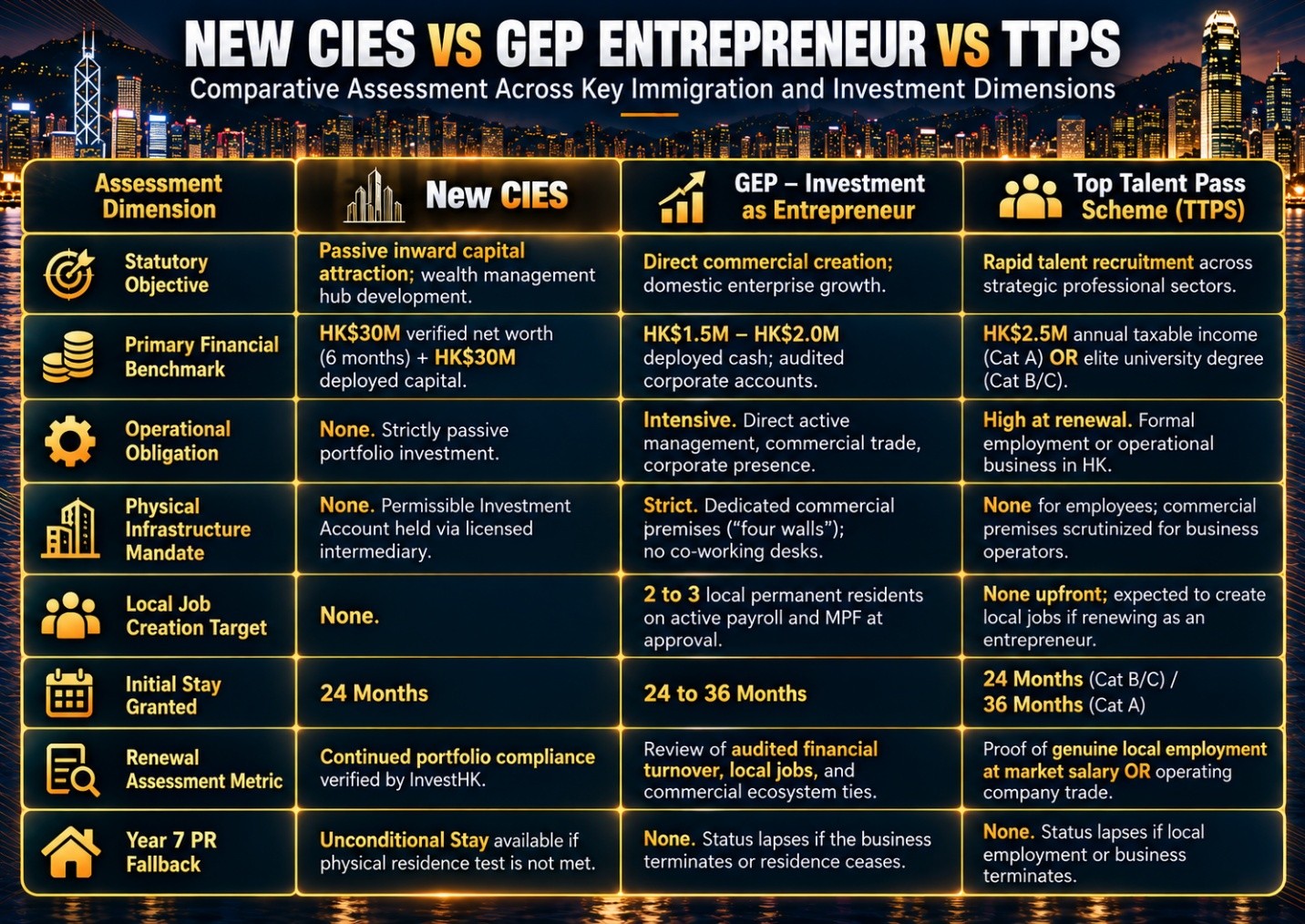
Comparative Analysis: New CIES vs. TTPS vs. GEP Entrepreneur

Strategic advisory begins by matching the client’s commercial realities, professional availability, and liquidity profile to the appropriate immigration channel. The following comparative matrix outlines the operational parameters of Hong Kong’s three premier business and capital immigration pathways:
The 7-Year Milestone: Right of Abode vs. Unconditional Stay

At the conclusion of the seven-year period, New CIES entrants reach the primary milestone of the scheme. Under Hong Kong immigration jurisprudence, an entrant who has held continuous status for seven years may access two distinct permanent options under the Immigration Ordinance (Cap. 115).
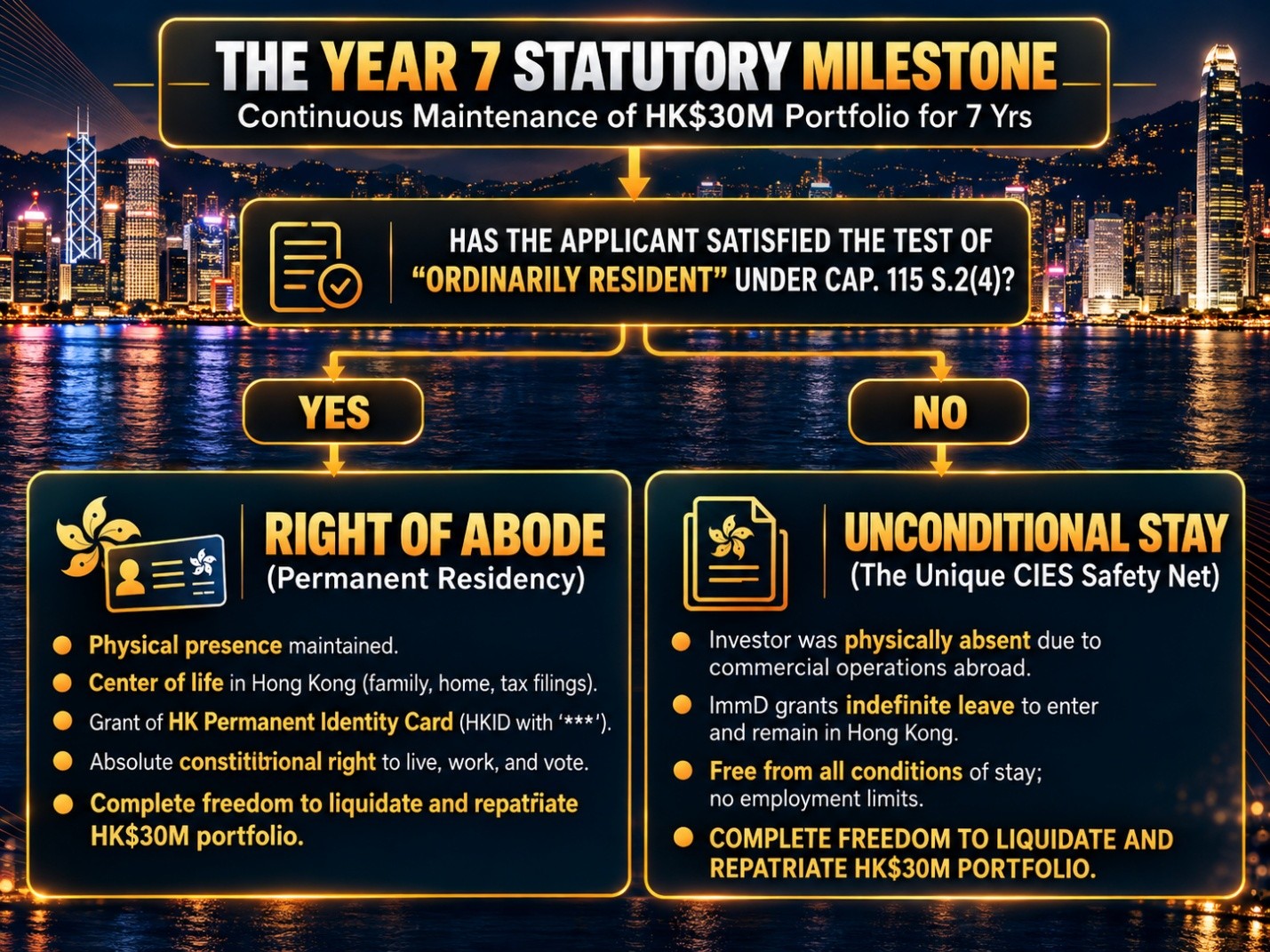
Option A: The Right of Abode (Permanent Residency)

Under paragraph 2 of Schedule 1 to the Immigration Ordinance, a person not of Chinese nationality who has entered Hong Kong with a valid travel document, has ordinarily resided in Hong Kong for a continuous period of not less than seven years, and has taken Hong Kong as their place of permanent residence is eligible to apply for the Right of Abode.

The applicant must satisfy the legal test of ordinary residence set out in Section 2(4) of the Immigration Ordinance. Adjudicating officers evaluate:

  1. The continuity and duration of physical presence in the territory;
  2. The maintenance of a permanent home for the applicant and their family;
  3. Whether immediate family members reside in Hong Kong;
  4. Local tax assessment and payment records; and
  5. The legitimate reasons for any extended absences from Hong Kong (e.g., temporary commercial assignments abroad).
  6. Other relevant factors.

Obtaining the Right of Abode confers permanent resident status, symbolized by the issuance of a Hong Kong Permanent Identity Card (bearing three stars). The holder acquires an absolute constitutional right to enter, live, work, establish businesses, and vote in Hong Kong, free from deportation or entry conditions. Upon the grant of Right of Abode, all CIES investment covenants terminate, and the HK$30 million portfolio may be liquidated, redeployed, or repatriated without restriction.

Option B: Unconditional Stay (The Unique CIES Privilege)

A critical feature of the New CIES—which sets it apart from every other visa scheme in Hong Kong—is the statutory safety net known as Unconditional Stay.

Many international investors, enterprise principals, and multi-jurisdictional family office heads find it difficult to satisfy the physical presence requirements of the ordinary residence test. Their global commercial obligations may require them to spend substantial periods outside the territory throughout the seven-year continuum. Under standard work or entrepreneur visas, prolonged physical absence can break the continuity of residence, resulting in the refusal of permanent residency and potentially the cancellation of extension permissions.

Under the New CIES framework:

If an entrant has continuously complied with the scheme’s investment rules for seven full years, but cannot satisfy the continuous physical residence test, they are entitled to apply for Unconditional Stay pursuant to the scheme rules, supported by the official Declaration for Submitting an Application for Unconditional Stay.

Upon grant, the entrant is released from all time limits, conditions of stay, and visa renewal cycles. They acquire the permanent right to enter and remain in Hong Kong, take up any employment, or operate any commercial business without restriction.

Immediate Capital Liquidation: Most importantly, upon the endorsement of Unconditional Stay, the investor’s statutory obligation to maintain the HK$30 million qualifying portfolio is permanently extinguished. The entrant may immediately sell, liquidate, and withdraw the entirety of the permissible financial assets, non-residential real estate, and their share of the HKIC CIES Investment Portfolio without impacting their right to live in Hong Kong.

Critical Practice Traps, Anti-Avoidance Rules, and Risk Mitigations

Drawing from decades of practitioner experience handling complex investor portfolios before the Immigration Department and statutory authorities, we have identified several recurrent compliance traps that can derail an application:

The Broken Chain in the 2-Year Lookback

The Net Asset Assessment requires an unbroken, verified chain of HK$30 million net equity. Applicants frequently err by presenting asset reports showing significant fluctuations where portfolio valuations dropped to HK$28 million during market downturns, before recovering to HK$35 million at the time of submission. Such drops represent an immediate statutory failure. Practitioners must conduct a line-item, daily balance audit across the full 730 days of the qualifying lookback before initiating formal CPA reporting.

Multi-Tiered and Intermingled Corporate Structures

Holding qualifying assets through offshore entities (such as British Virgin Islands, Cayman Islands, or Jersey structures) is permissible only where the applicant is the sole legal and beneficial owner (100%) of the underlying corporate vehicle. Assets held through trusts, family foundations, or operating companies with minority shareholders present significant evidential hurdles. Unless the applicant exercises direct, absolute, unencumbered ownership and control over the specific equity interest, the New CIES Office will exclude those holdings from the net asset baseline.

Misunderstanding the Non-Residential Property Cap

Purchasers often commit substantial capital to commercial real estate under the mistaken impression that real estate expenditures absorb the entire HK$30 million obligation. The statutory cap on non-residential real estate is strictly fixed at HK$10 million. If an investor acquires a commercial floor in Wan Chai or an industrial unit in Kwun Tong for HK$25 million, only HK$10 million can be credited toward the scheme. The investor must still deploy the remaining HK$17 million into eligible financial assets inside a PIA, alongside remitting HK$3 million into the HKIC Investment Portfolio.

Overlooking the 14-Day Portfolio Rebalancing Window

Market conditions routinely necessitate portfolio rebalancing. However, letting gross redemption proceeds sit idle in cash for longer than 14 calendar days breaches scheme covenants. Intermediaries are bound by compliance reporting undertakings to disclose these lapses to InvestHK. Discretionary investment managers and family office chief investment officers must establish automated execution workflows to guarantee that when securities are sold, qualifying replacement assets are settled within the statutory 14-day limit.

Encumbrances and Margin Facilities

High-net-worth investors frequently manage financial assets through leveraged private banking lines, lombard loans, or margin accounts. Pledging or borrowing against assets held in the Permissible Investment Account is strictly prohibited. The HK$27 million portfolio must remain completely unencumbered. Any evidence of collateral assignment or margin borrowing against qualifying assets can trigger immediate compliance inquiries from InvestHK, leading to the cancellation of eligibility and refusal of upcoming extensions.

Strategic Advisory Directive & Conclusion

Hong Kong’s immigration landscape reflects a deliberate, strategic realignment. The era of loose, ill-defined immigration gateways has drawn to a definitive close:

The Top Talent Pass Scheme has graduated from an initial attraction exercise into an economic performance review, requiring active employment or commercial trade to sustain continued residence.

The GEP Investment as Entrepreneur framework has hardened into an institutional-grade gateway, closing the door on speculative startups and demanding fully deployed capital (HKD 1.5M–2.0M), dedicated commercial premises (“four walls”), and immediate local payrolls.

The New Capital Investment Entrant Scheme represents the government’s dedicated pathway for pure capital deployment. It provides international investors and their families a secure, passive, and rule-bound corridor to residency, backed by the safety net of Unconditional Stay at Year 7.

Because the New CIES operates under a bifurcated statutory mechanism, successful execution depends upon synchronized coordination among certified public accountants, licensed financial intermediaries, private wealth managers, and specialized immigration counsel. Structuring the initial asset history, managing ongoing portfolio rebalancing within statutory limits, and preparing extension filings are tasks where precision is paramount.

For prospective entrants, family offices, and wealth advisory institutions:

Procedural Blueprints & Case Preparation: Review comprehensive statutory workflows and procedural guidance at the Hong Kong Visa Handbook.

Direct Representation & Legal Counsel: For complex multi-jurisdictional asset verification, cross-border corporate structures, and formal representation before InvestHK and the Immigration Department, consult the Hong Kong Visa Centre.

Policy Analysis & Administrative Guidance: Follow ongoing analytical updates and practice commentaries directly at Hong Kong Visa Geeza.

More Stuff You May Find Useful or Interesting

  1. Capital Investment Entrant Scheme Suspended – Business Investment Visa Gets a Boost!

How the content must now be read in light of current ImmD and InvestHK policy:

In this seminal commentary authored by Stephen Barnes, the Hong Kong Visa Geeza, on the 2015 suspension of the Capital Investment Entrant Scheme, our practice documented the government’s historic pivot away from passive wealth importation toward active commercial development under the Hong Kong Investment as Entrepreneur framework. While that analysis remains an invaluable historical record of why the original HK$10 million scheme was shuttered, practitioners must not apply its legacy assumptions today. The government has fully reinstated passive capital migration under the [New Capital Investment Entrant Scheme (New CIES)](https://hongkongvisageeza.com/navigating-the-new-capital-investment-entrant-scheme/), elevating the baseline commitment to HK$30 million. Furthermore, while the old scheme permitted high-end residential real estate purchases, the Hong Kong Visa Geeza’s updated New CIES Practice Direction highlights that residential property is now strictly barred, capping non-residential real estate at HK$10 million and introducing a mandatory HK$3 million ring-fenced allocation to the state-backed Hong Kong Investment Corporation (HKIC) portfolio.

  1. Hong Kong Unconditional Stay Status vs. the Right of Abode for CIES Visa Holders

How the content must now be read in light of current ImmD and InvestHK policy:

This cornerstone Q&A analysis by Stephen Barnes (The Hong Kong Visa Geeza) examining Unconditional Stay versus the Right of Abode remains the definitive practitioner authority on Year 7 exit strategies under the Immigration Ordinance (Cap. 115). While holding a residence visa for seven continuous years is widely assumed to lead automatically to a Permanent Identity Card, Stephen Barnes explains the continuous ordinary residence test and why mobile international investors often fall short due to extended overseas business travel. Under the New CIES, this strategic dynamic is reinforced: entrants who maintain their qualifying HK$30 million portfolio for seven years but fail the physical presence test can still secure [Unconditional Stay status in Hong Kong](https://hongkongvisageeza.com/hong-kong-unconditional-stay-a-practical-guide-business-immigration-to-hong-kong/). Crucially, once Unconditional Stay is endorsed, the investor is freed from all immigration conditions of stay and is legally entitled to liquidate and repatriate the entire HK$30 million investment portfolio immediately.

  1. What’s the Minimum Capital Required for a Hong Kong Business Investment Visa?

How the content must now be read in light of current ImmD and InvestHK policy:

In this widely cited article by the Hong Kong Visa Geeza on minimum capital thresholds for Hong Kong visas, the flexible, case-by-case nature of the active Entrepreneur route was contrasted with the rigid capital minimums of the CIES. While readers historically learned that an Entrepreneur visa could be secured with modest initial capital (HK$300,000 to HK$400,000) provided the commercial rationale was sound, Stephen Barnes’ Practice Update on the Upgraded Entrepreneur Visa Regime confirms that era has definitively closed. Today, the Immigration Department benchmarks genuine entrepreneurial substance against TTPS Category A, demanding HK$1.5M to HK$2.0M in deployed liquidity, dedicated commercial premises (“four walls”), and immediate local payrolls. Consequently, for high-net-worth investors unwilling to shoulder intensive operational overheads, the New CIES passive investment route stands as the sole immigration corridor where capital deployment replaces commercial enterprise scrutiny.

  1. Hong Kong Investment Visa Applications – What’s Involved?

How the content must now be read in light of current ImmD and InvestHK policy:

This comprehensive foundational review by Stephen Barnes, the Hong Kong Visa Geeza, detailing what is involved in Hong Kong investment visa applications walks prospective applicants through the arduous approvability test, document preparation, and procedural friction of active business applications. However, readers evaluating inward investment must now bifurcate their strategic roadmap: active business founders remain subject to the four-to-six-month departmental review, whereas New CIES applicants bypass the operational approvability test altogether. As the Hong Kong Visa Geeza outlines in our procedural roadmap, the New CIES introduces a dual-agency administrative model where the applicant’s historical financial capability is audited first by the New CIES Office of InvestHK, followed by ImmD’s issuance of an Approval-in-Principle (AIP) granting a 180-day visitor stay to execute the qualifying HK$30 million portfolio.

  1. Hong Kong Business Investment Visas – The Catch-22 for Foreign National Entrepreneurs

How the content must now be read in light of current ImmD and InvestHK policy:

In this authoritative practice piece, Stephen Barnes formulated the famous Catch-22 of Hong Kong entrepreneur visas, wherein an in-country applicant cannot establish operational contribution without participating in the business, yet cannot lawfully work in the business until visa endorsement is secured. While active founders must still navigate this procedural conundrum via early submission, the Hong Kong Visa Geeza’s latest New CIES guidance reveals that passive investors under the New CIES avoid this Catch-22 entirely. Because New CIES entrants are admitted on the strength of personal capital managed inside a Permissible Investment Account (PIA) with an Eligible Financial Intermediary, there is no requirement to start trading before approval. Furthermore, once admitted, a New CIES visa holder has the unrestricted legal freedom to invest in, start, or manage commercial enterprises in Hong Kong without seeking independent permission from the Immigration Department.

VisaGeeza.Ai – Making Hong Kong Immigration A Lot Easier

Dependant Visa to an Employment Visa in Hong Kong

VisaGeeza.Ai – 13 Years In The Making

Check Out VisaGeeza.Ai

All Our Know-How : All Our Experience : Fully Interactive

100% FREE!

Please select the social network you want to share this page with:

13

Oct 2026

PRACTICE UPDATE: Hong Kong’s IANG Visa – From Graduate Retention to Economic Participation

Posted by / in Musing, Special Programmes / No responses

Practice Direction: Hong Kong’s IANG Visa – From Graduate Retention to Economic Participation

A Major Strategic Shift in the Immigration Arrangements for Non-local Graduates

For many years, Hong Kong’s Immigration Arrangements for Non-local Graduates (IANG) have provided one of the territory’s most accessible pathways from education into professional employment.

Unlike traditional employment visa arrangements, the IANG recognises that a qualifying graduate should have the opportunity to establish a career in Hong Kong without necessarily securing a job before making an initial application.

This flexibility has made the scheme an important component of Hong Kong’s strategy to attract international students, retain educated talent and develop its professional workforce.

However, the policy environment surrounding the IANG has evolved considerably.

The extension of the scheme to qualifying graduates of university campuses in the Guangdong-Hong Kong-Macao Greater Bay Area, improvements to permitted periods of stay and revised extension procedures all reflect a more integrated approach to talent development.

At the same time, the Immigration Department continues to distinguish between a graduate’s initial entitlement to seek admission and the substantive requirements governing continued residence.

The essential distinction is that a qualifying academic background can open the door to Hong Kong, but continued residence ordinarily requires a credible employment or business connection with the territory.

This Practice Direction examines how those developments should influence immigration planning for international graduates, employers and entrepreneurs.

The Expansion of IANG Beyond Hong Kong’s Traditional University System

Historically, the IANG was principally associated with non-local students who completed qualifying full-time, locally accredited programmes in Hong Kong.

The Government subsequently extended the arrangements to qualifying graduates of higher education institutions jointly established by Mainland and Hong Kong universities in Mainland cities of the Greater Bay Area.

This development is strategically significant.

It recognises that Hong Kong’s future professional workforce will not necessarily be educated exclusively within the territory’s geographical boundaries.

Increasingly, universities, research institutions, technology businesses and professional services firms operate within a wider Greater Bay Area ecosystem.

By extending IANG eligibility to qualifying GBA campus graduates, Hong Kong has created an additional pathway through which individuals educated within that regional environment may enter its employment market.

However, applicants must establish that their institution and programme meet the specific requirements.

Graduating from any university situated within the Greater Bay Area does not automatically establish eligibility.

Recent and Non-Recent Graduates: An Important Distinction

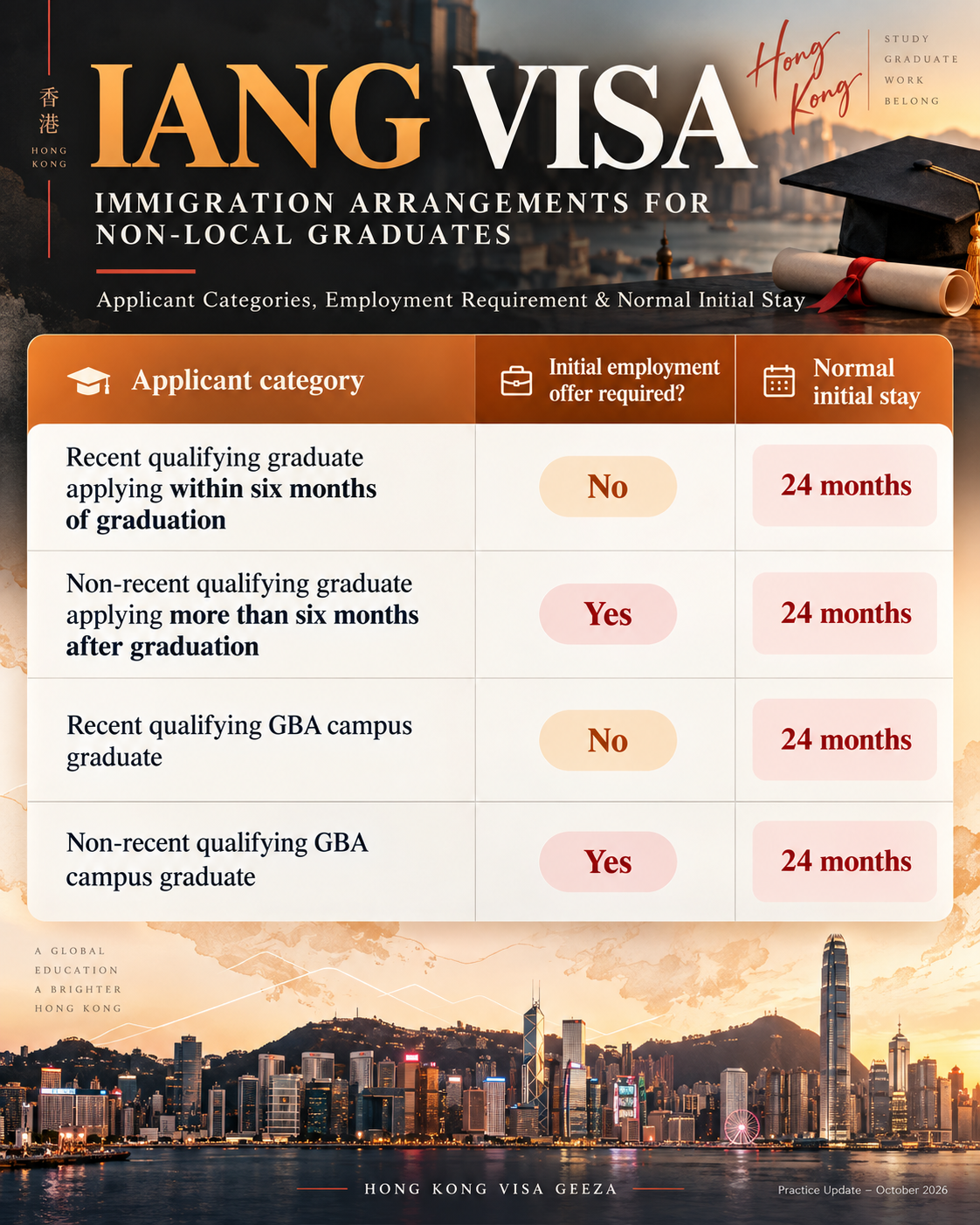
The IANG continues to distinguish between recent and non-recent graduates.

For recent graduates, the ability to obtain immigration permission without a prior employment offer remains one of the scheme’s most valuable advantages.

It provides time to investigate employment opportunities, establish professional networks and consider entrepreneurial activities.

Non-recent graduates, by contrast, must ordinarily demonstrate that they have secured qualifying employment at a level commonly taken up by degree holders and with remuneration consistent with the market.

The distinction is therefore not simply administrative.

It affects the evidence that applicants must produce and the way in which they should prepare their immigration applications.

The Revised 2+3+3 Framework

An important enhancement to the IANG was the replacement of the previous 1+2+2+3 pattern of stay with a more favourable 2+3+3 arrangement.

Under the current framework, successful applicants are normally granted an initial period of 24 months.

Qualifying extensions may then be granted for periods of up to three years, subject to the applicable conditions and the applicant’s circumstances.

This provides greater stability for graduates seeking to establish their professional careers.

However, the availability of a longer initial period should not be confused with an unconditional right to remain in Hong Kong throughout subsequent extensions.

The initial permission provides an opportunity to develop the employment or business circumstances necessary to support continued residence.

The Extension Stage: Where Economic Participation Becomes Critical

The most important practical issue for IANG entrants arises when their initial permission approaches expiry.

At this stage, the Immigration Department ordinarily expects applicants to demonstrate that they have taken up appropriate employment in Hong Kong or established or joined a genuine business.

For employed applicants, the Department considers whether the position is appropriate for a degree holder and whether the remuneration package is consistent with prevailing market conditions.

The Department may also consider the applicant’s employment circumstances and the economic benefits associated with the position.

For applicants who have established or joined a business, the assessment may include the enterprise’s operations, development, economic contribution and the applicant’s involvement.

This is particularly relevant for graduates who initially entered Hong Kong without employment and subsequently moved into entrepreneurship.

A registered company, by itself, should not be assumed to establish sufficient grounds for an extension.

Applicants should be prepared to demonstrate genuine commercial activity.

Entrepreneurial Graduates: The Importance of Business Substance

Hong Kong’s innovation economy increasingly encourages graduates to establish technology businesses, professional consultancies and other commercial enterprises.

The IANG offers flexibility for qualifying graduates to pursue these opportunities.

Nevertheless, entrepreneurial applicants should understand that the extension process requires more than evidence of company incorporation.

Depending upon the circumstances, useful evidence may include:

* Business registration and corporate records.
** Contracts, customer relationships and commercial transactions.
*** Financial statements and evidence of investment.
**** Product development, research or commercialisation activities.
***** Office arrangements, staffing and operational expenditure.
****** Evidence of the applicant’s actual involvement in the business.

An early-stage enterprise may not yet be profitable, but it should still be capable of demonstrating credible business activity and development.

The Immigration Department assesses the circumstances of each application rather than applying a universal published minimum-turnover requirement to every IANG entrepreneur.

Greater Bay Area Integration and Hong Kong’s New Economic Direction

The significance of the expanded IANG arrangements becomes clearer when viewed alongside Hong Kong’s wider economic development strategy.

Hong Kong’s first Five-Year Plan for 2026–2030 places considerable emphasis on innovation, technology, research, advanced industries and closer economic integration with Mainland China.

The Greater Bay Area is particularly important to this strategy.

Hong Kong’s role as an international financial, commercial and professional services centre is increasingly being developed alongside the manufacturing, technology and research capabilities of neighbouring cities, particularly Shenzhen.

The extension of IANG eligibility to qualifying GBA campus graduates fits naturally within that broader direction.

It creates additional opportunities for graduates educated within the regional university ecosystem to participate in Hong Kong’s economy.

Nevertheless, applicants should distinguish this strategic policy context from the formal eligibility requirements.

The Five-Year Plan does not automatically create new IANG entitlements, nor does it replace the Immigration Department’s published admission and extension criteria.

The 2026 Extension Application Window

Another practical development concerns the timing of extension applications.

Under the current arrangements, IANG entrants may submit extension applications within three months before the expiry of their existing limit of stay.

This provides additional time to assemble documentation and address potential issues.

However, it is important to appreciate that filing an extension application does not automatically authorise an applicant to remain in Hong Kong beyond their existing permitted stay.

Applicants should monitor expiry dates carefully and comply with Immigration Department instructions while their applications are being considered.

The longer application window should therefore be used for proper preparation, not as a substitute for it.

The Top-Tier Employment Stream

The IANG also offers a top-tier extension arrangement for qualifying entrants.

Individuals who have been permitted to remain in Hong Kong under the scheme for at least two years and have assessable salaries-tax income of not less than HK$2 million in the previous year of assessment may qualify for consideration for a six-year extension.

This arrangement provides an additional incentive for economically successful graduates to remain in Hong Kong.

However, applicants should not confuse personal wealth, company turnover or gross business receipts with the specific assessable salaries-tax income required under the arrangement.

Appropriate tax documentation is therefore essential.

Practical Guidance for IANG Applicants

The developments outlined above suggest several important considerations.

Plan beyond the initial visa. Graduates should use their initial period of stay to establish a credible employment or business position.

Check academic eligibility carefully. This is particularly important for GBA campus graduates and applicants whose qualifications involve collaborative or cross-border programmes.

Maintain employment records. Contracts, remuneration evidence, employer correspondence and tax documentation may become important at extension stage.

Document entrepreneurial activities. Graduates establishing businesses should maintain evidence of genuine commercial operations and progress.

Understand the recent-graduate deadline. The six-month distinction can materially affect whether an initial employment offer is required.

Prepare extension applications early. The three-month application window provides useful flexibility, but substantive eligibility must still be established.

The Wider Implications for Hong Kong Immigration Practice

The evolution of the IANG illustrates an important feature of Hong Kong’s developing talent strategy.

The Government is not simply seeking to attract highly educated individuals.

It is seeking to create conditions in which those individuals can establish careers, develop businesses and contribute to the territory’s long-term economic development.

The inclusion of qualifying Greater Bay Area graduates broadens the geographical reach of that strategy.

The longer permitted periods of stay provide additional stability.

And the extension framework ensures that continued residence remains connected to genuine employment or business activity.

For international graduates, the message is clear:

Your qualification may establish your eligibility to enter Hong Kong under the IANG. Your subsequent employment or business activities will ordinarily determine the strength of your application to remain.

Understanding that distinction from the outset is essential to effective immigration planning.

More Stuff You May Find Useful or Interesting

IANG Work Visa for Non-Local Graduates: The Ultimate Guide

According to Stephen Barnes in Practice Update: Hong Kong’s IANG Visa, the Immigration Arrangements for Non-local Graduates have shifted from a traditional post-study retention route into a cross-border regional talent channel encompassing qualifying campuses across the Greater Bay Area under Hong Kong’s 2026–2030 Five-Year Plan. In contrast to the baseline procedural overview set out by the Hong Kong Visa Geeza at the historical IANG Work Visa Information Archive, which focused primarily on graduate classification criteria and immediate entry mechanisms, the updated directive treats academic qualifications merely as an entry mechanism rather than an enduring entitlement: “The essential distinction is that a qualifying academic background can open the door to Hong Kong, but continued residence ordinarily requires a credible employment or business connection with the territory.”

Examining the operational framework and extension procedures reveals how policy continuity intersects with heightened scrutiny over time. The historical overview in the archive and the modern directive both track the 2+3+3 pattern of stay, but the updated Practice Direction embeds this within an expanded 3-month pre-expiry application window and an accelerated 6-year Top-Tier extension for graduates earning at least HK$2 million in assessable salaries-tax income. As Stephen Barnes outlines regarding this operational baseline: “Under the current framework, successful applicants are normally granted an initial period of 24 months. Qualifying extensions may then be granted for periods of up to three years, subject to the applicable conditions and the applicant’s circumstances.”

Substantively, the regulatory emphasis has evolved from highlighting procedural flexibility—such as changing employers without prior Immigration Department consent—to enforcing rigorous standards of economic contribution, particularly for self-employed graduates. While the legacy guide framed the scheme around open employment mobility, the modern Practice Direction makes clear that entrepreneurial applicants seeking to extend their stay cannot rely on bare corporate formalities or paper entities. Stephen Barnes defines this strict evidentiary hurdle: “A registered company, by itself, should not be assumed to establish sufficient grounds for an extension. Applicants should be prepared to demonstrate genuine commercial activity.”

 What Does the Immigration Department Look for When Establishing the Bona Fides of an IANG Employer?

According to Stephen Barnes in Practice Update: Hong Kong’s IANG Visa, the Immigration Arrangements for Non-local Graduates have transitioned from a mechanism for post-study talent retention into an active economic participation scheme integrated within the Greater Bay Area under Hong Kong’s 2026–2030 Five-Year Plan. In contrast to the practical inquiry addressed by the Hong Kong Visa Geeza in Establishing the Bona Fides of a Hong Kong Employer as a Suitable and Credible Sponsor, which focused on whether specific corporate balance-sheet metrics govern employer sponsorship, the updated Practice Update emphasizes that continuous lawful stay requires an authentic economic anchor: “The essential distinction is that a qualifying academic background can open the door to Hong Kong, but continued residence ordinarily requires a credible employment or business connection with the territory.”

Regarding the operational scrutiny of sponsoring entities, the legacy guidance and the updated Practice Direction converge on the principle that the Immigration Department looks beyond formal financial thresholds to evaluate organizational reality. While the historical case response clarifies that profitability is not a mandatory prerequisite provided the sponsor is sizable, established, or supported by a comprehensive business plan if under twelve months old, the updated Practice Direction frames this within the modern 2+3+3 pattern of stay and an expanded 3-month renewal filing window. As Stephen Barnes explains regarding this operational baseline: “Under the current framework, successful applicants are normally granted an initial period of 24 months. Qualifying extensions may then be granted for periods of up to three years, subject to the applicable conditions and the applicant’s circumstances.”

Substantively, the regulatory concern across both analyses centers on preventing artificial or nominal arrangements designed solely to preserve residence. The legacy guidance cautioned against contrived job offers concocted by associates to bypass immigration scrutiny, while the modern Practice Direction applies an identical standard of commercial reality to entrepreneurial graduates transitioning from employment into self-directed ventures. Highlighting the necessity of demonstrable trading over paper formalities, Stephen Barnes confirms the evidentiary threshold: “A registered company, by itself, should not be assumed to establish sufficient grounds for an extension. Applicants should be prepared to demonstrate genuine commercial activity.”

How Easy Is It to Secure an IANG Work Visa on the Basis of Freelance Employment?

According to Stephen Barnes in Practice Update: Hong Kong’s IANG Visa, the Immigration Arrangements for Non-local Graduates have transitioned from a mechanism for post-study retention into an active economic participation scheme integrated across the Greater Bay Area under Hong Kong’s 2026–2030 Five-Year Plan. In contrast to the specific advisory scenario examined by the Hong Kong Visa Geeza at How Easy Is It To Secure A Work Visa Issued Under The Immigration Arrangements For Non-Local Graduates On The Basis Of Freelance Employment?, which addressed whether an entrant can break away from corporate sponsorship to pursue freelance consulting, the updated Practice Update firmly establishes that continuing residence cannot rest on academic status alone: “The essential distinction is that a qualifying academic background can open the door to Hong Kong, but continued residence ordinarily requires a credible employment or business connection with the territory.”

Examining the mechanics of ongoing stay, both sources highlight a critical divergence between an entrant’s daily operational freedom and their formal legal obligations at extension milestones. The legacy analysis observes that an IANG holder who departs an employer mid-visa can freelance during their unexpired permission—or even cross the seven-year continuous residence threshold for the Right of Abode without triggering an active employment inquiry—yet warns that seeking a renewal on the basis of self-employment historically invoked the demanding “substantial contribution” approvability test of a full investment visa. In contrast, the modern directive replaces ad-hoc renewals with an expansive 2+3+3 pattern of stay and an expanded 3-month filing window, offering greater runway for legitimate career progression. As Stephen Barnes outlines regarding this operational baseline: “Under the current framework, successful applicants are normally granted an initial period of 24 months. Qualifying extensions may then be granted for periods of up to three years, subject to the applicable conditions and the applicant’s circumstances.”

Substantively, the regulatory threshold for independent professionals and business founders has evolved from ambiguous hurdles into a clear standard of commercial reality. While the legacy advisory cautioned that sustaining freelance activity at renewal was an uphill battle without a sizable business structure, the modern Practice Direction clarifies that immigration authorities assess genuine business activity rather than demanding arbitrary turnover figures, while strictly disqualifying nominal or paper arrangements. As Stephen Barnes defines the evidentiary baseline for self-employed graduates: “A registered company, by itself, should not be assumed to establish sufficient grounds for an extension. Applicants should be prepared to demonstrate genuine commercial activity.”

Hong Kong Visas – Immigration Arrangements for Non-local Graduates: A Practical Guide

According to Stephen Barnes in Practice Update: Hong Kong’s IANG Visa, the Immigration Arrangements for Non-local Graduates have transitioned from a localized retention channel into an active economic participation scheme integrated across the Greater Bay Area under Hong Kong’s 2026–2030 Five-Year Plan. In contrast to the specific advisory scenario examined by the Hong Kong Visa Geeza at How Easy Is It To Secure A Work Visa Issued Under The Immigration Arrangements For Non-Local Graduates On The Basis Of Freelance Employment?, which addresses whether an entrant can break away from corporate sponsorship to pursue freelance consulting, the updated Practice Direction firmly establishes that continuing residence cannot rest on academic status alone: “The essential distinction is that a qualifying academic background can open the door to Hong Kong, but continued residence ordinarily requires a credible employment or business connection with the territory.”

Examining the mechanics of ongoing stay, both sources highlight a critical divergence between an entrant’s day-to-day operational freedom and their formal legal obligations at extension milestones. The legacy analysis and accompanying podcast recording observe that an IANG holder who departs an employer mid-visa can freelance during their unexpired permission—or even cross the seven-year continuous residence threshold for the Right of Abode without triggering an active employment inquiry—yet warns that seeking a renewal on the basis of self-employment historically invoked the demanding “substantial contribution” approvability test of a full investment visa. In contrast, the modern directive replaces ad-hoc renewals with an expansive 2+3+3 pattern of stay and an expanded 3-month filing window, offering greater runway for legitimate career progression. As Stephen Barnes outlines regarding this operational baseline: “Under the current framework, successful applicants are normally granted an initial period of 24 months. Qualifying extensions may then be granted for periods of up to three years, subject to the applicable conditions and the applicant’s circumstances.”

Substantively, the regulatory threshold for independent professionals and business founders has evolved from ambiguous hurdles into a clear standard of commercial reality. While the legacy advisory cautioned that sustaining freelance activity at renewal was an uphill battle without a sizable business structure, the modern Practice Direction clarifies that immigration authorities assess genuine business activity rather than demanding arbitrary turnover figures, while strictly disqualifying nominal or paper arrangements. As Stephen Barnes defines the evidentiary baseline for self-employed graduates: “A registered company, by itself, should not be assumed to establish sufficient grounds for an extension. Applicants should be prepared to demonstrate genuine commercial activity.”

Visas to Live, Work or Establish a Business in Hong Kong – IANG

According to Stephen Barnes in Practice Update: Hong Kong’s IANG Visa, the Immigration Arrangements for Non-local Graduates have evolved from a standalone academic-to-employment bridge into an active instrument of regional economic integration aligned with the Greater Bay Area and Hong Kong’s 2026–2030 Five-Year Plan. In contrast to the tactical route presented by the Hong Kong Visa Geeza in Visas To Live, Work or Establish A Business In Hong Kong – IANG, which framed enrolment in a local master’s degree as a strategic backdoor to secure a two-year commercial runway without prior work experience, the updated Practice Direction makes clear that entry rights must not be mistaken for ongoing residence entitlements: “The essential distinction is that a qualifying academic background can open the door to Hong Kong, but continued residence ordinarily requires a credible employment or business connection with the territory.”

On procedural structure and duration of stay, both sources highlight the immense strategic advantage of the initial post-graduation grant, though within different regulatory perspectives. The historical guide highlights that eligible graduates receive an open, no-questions-asked 24-month permission allowing them to operate freely or establish a venture before seeking subsequent extensions, while the modern directive integrates this initial grant into the 2+3+3 pattern of stay, supplemented by an expanded three-month pre-expiry application window and a dedicated six-year Top-Tier extension stream. As Stephen Barnes outlines regarding this operational baseline: “Under the current framework, successful applicants are normally granted an initial period of 24 months. Qualifying extensions may then be granted for periods of up to three years, subject to the applicable conditions and the applicant’s circumstances.”

Substantively, the regulatory benchmark governing entrepreneurial graduates has matured from an ambiguous “substantial contribution” investment test into an objective assessment of operational commercial reality. Where the legacy analysis noted that founders extending their IANG stay under their own enterprise had to demonstrate substantial economic contributions—effectively mirroring the steep approvability bar of a business investment visa—the updated Practice Direction removes arbitrary turnover prerequisites while aggressively penalizing nominal corporate shells. Establishing the evidentiary standard for graduate founders seeking extensions, Stephen Barnes concludes: “A registered company, by itself, should not be assumed to establish sufficient grounds for an extension. Applicants should be prepared to demonstrate genuine commercial activity.”

VisaGeeza.Ai – Making Hong Kong Immigration A Lot Easier

TTPS

VisaGeeza.Ai – 13 Years In The Making

Check Out VisaGeeza.Ai

All Our Know-How : All Our Experience : Fully Interactive

100% FREE!

Please select the social network you want to share this page with:
12

Oct 2026

PRACTICE UPDATE: Hong Kong’s Top Talent Pass Scheme (TTPS) Moves from Talent Attraction to Economic Contribution

Posted by / in Musing, Practice Update, Top Talent Pass / No responses

A Major Strategic Shift: Hong Kong’s Top Talent Pass Scheme (TTPS) Moves from Talent Attraction to Economic Contribution

Hong Kong’s Top Talent Pass Scheme (TTPS)

The Top Talent Pass Scheme (TTPS) was introduced by the Hong Kong Special Administrative Region (HKSAR) Government in late 2022 as the flagship initiative of an aggressive campaign to recruit global expertise and high-earning professionals. Announced during Chief Executive John Lee’s maiden Policy Address, the program was crafted to counter workforce contraction, offset demographic aging, and reaffirm Hong Kong’s position as a premier international business, financial, and technological gateway.

Unlike traditional employment visas that require an upfront local job offer, the TTPS offers an unconstrained pathway to residency, granting approved candidates the freedom to seek employment, change roles, establish commercial enterprises, or explore academic and professional collaborations immediately upon arrival.

Policy Genesis and Strategic Objectives

Between 2020 and 2022, structural shifts and global economic headwinds led to a contraction in Hong Kong’s local labor pool, particularly across banking, information technology, legal compliance, and engineering. Historically, immigration into Hong Kong relied primarily on two frameworks:

  1. General Employment Policy (GEP) / Admission Scheme for Mainland Talents and Professionals (ASMTP): Employer-driven programs requiring a confirmed job offer before arrival, strict salary benchmarks, and demonstration that local candidates could not readily fill the position.
  2. Quality Migrant Admission Scheme (QMAS): A points-based quota mechanism that, while open without prior employment, involved comprehensive assessments, extensive review panels, and processing timelines spanning six to twelve months.

Recognizing the need for a nimble, fast-track alternative, the government modeled the TTPS around objective, verifiable metrics rather than subjective committee scoring. By stripping away employer sponsorship requirements and relying on concrete earnings benchmarks and top-tier university credentials, immigration authorities transformed the assessment process into a rapid, largely automated administrative evaluation.

Core Eligibility Streams

The TTPS groups prospective applicants into three distinct categories based on their financial track record or academic background:

Category A:

Category A targets individuals whose assessable personal income reached HK$2.5 million (or its equivalent in recognized foreign currencies) within the 12 months immediately preceding application.

– Income Definition: Qualifying income includes taxable employment earnings, salaries, bonuses, allowances, stock options, and net business profits from wholly or majority-owned companies.

– Exclusions: Passive earnings such as personal investment returns, stock market appreciation, rental yields, capital gains, and gift transfers are excluded.

– Academic Exemption: Applicants under this stream are not required to hold an undergraduate degree, creating an open channel for self-made entrepreneurs, executive leaders, and specialized founders.

Category B: Experienced Top-Tier University Graduates

Category B requires applicants to hold a bachelor’s degree awarded by an institution listed on the official Aggregate List of Eligible Universities, alongside at least three years of cumulative work experience within the five years preceding the application date.

– No Cap: This category operates without an annual quota.

– Experience Requirement: Work experience can span non-contiguous periods and diverse fields, provided it is verified by employment certificates, tax statements, and official employer confirmations.

Category C: Recent Top-Tier University Graduates

Category C caters to emerging graduates who earned an eligible bachelor’s degree within the preceding five years but possess less than three years of professional work experience.

– Annual Quota: To prevent sudden wage depression at entry levels and balance local graduate employment, Category C is capped at 10,000 admissions per fiscal year, allocated on a first-come, first-served basis.

– Local Student Exclusion: Non-local students who already obtained their degree in Hong Kong are excluded from Category C, as they already qualify under the dedicated Immigration Arrangements for Non-local Graduates (IANG).

The University Aggregate List: Verification and Limits

Eligibility for Categories B and C is governed by the Aggregate List of Eligible Universities, compiled by the Labour and Welfare Bureau. The index aggregates the world’s top 100 institutions from four global ranking tables over a multi-year window:

– Quacquarelli Symonds (QS) World University Rankings
– Times Higher Education (THE) World University Rankings
– U.S. News & World Report Best Global Universities Rankings
– ShanghaiRanking’s Academic Ranking of World Universities (ARWU)

The list includes elite institutions across North America, Europe, Asia, and Australasia, along with prestigious mainland Chinese institutions under the national double-first-class initiative.

Crucial Academic Criteria

  1. Undergraduate Degree Exclusivity: The qualifying degree must be an. Individuals holding a master’s or doctoral degree from a top 100 university without an eligible bachelor’s degree do not qualify for Categories B or C.,
  2. Campus Structure: Degrees obtained through continuing education colleges, evening schools, offshore affiliated branch colleges, or distance-learning subsidiaries are generally disqualified.
  3. Third-Party Verification: Diplomas must be authenticated through recognized clearinghouses (such as the China Higher Education Student Information and Career Center, or credential evaluations from official national qualification authorities).

Application Mechanics and Dependant Entitlements

The application is administered digitally through the Immigration Department’s electronic visa platform.

– Documentation Requirements: Category A candidates submit certified tax assessment notices, audited business financial statements, and company ownership filings. Categories B and C require degree certificates, transcripts, and verified employment letters.

– Processing Timelines: Straightforward applications are routinely processed within one to four weeks, presenting a stark contrast to older points-based pathways.

– Family Inclusion: Primary permit holders can sponsor immediate dependants—legally recognized spouses and unmarried, dependent children under the age of 18. Dependants enjoy full access to the territory: spouses may take up employment or start businesses without independent visa sponsorships, and children are entitled to enroll in local primary and secondary schools as well as private international institutions.

Initial Stay Permissions and Economic Integration

Successful applicants receive an electronic visa permitting an initial unconditional period of stay in Hong Kong. During this initial entry period:

– Employment Flexibility: Entrants are not tied to a single sponsor. They can switch jobs, take on multiple concurrent appointments, accept contract consultancy work, or establish independent commercial entities without prior immigration approval.

– Local Rights: Holders obtain a Hong Kong Identity Card (HKID), opening access to local banking services, commercial leasing, driving licenses, and public healthcare facilities on the same tier as local residents.

– Path to Permanent Residency: Years spent residing in Hong Kong under the TTPS accumulate toward the seven-year continuous ordinary residence threshold required to apply for the Right of Abode (Permanent Resident status) under the Basic Law.

Economic Impact and Broader Implications

Since its deployment, the scheme has generated tens of thousands of approvals, injecting a high-density cluster of software engineers, quantitative traders, fintech specialists, and cross-border consultants into Hong Kong’s core sectors.

By lowering entry friction and granting professionals the latitude to explore the local ecosystem on arrival, Hong Kong has repositioned itself as a dynamic talent magnet. The TTPS remains the cornerstone of the city’s broader strategy to anchor international capital, power the Northern Metropolis development, and deepen economic integration across the Guangdong-Hong Kong-Macao Greater Bay Area.

The Evolving Assessment Regime for TTPS & Subsequent Extensions of Stay

Over the past three and a half decades of advising on Hong Kong immigration law, policy and administrative practice, we have witnessed numerous shifts in the way the Immigration Department (ImmD) evaluates foreign professionals seeking to establish and maintain their presence in Hong Kong.

Few developments, however, illustrate the changing relationship between immigration policy and economic development more clearly than the evolution of the Top Talent Pass Scheme (TTPS).

Introduced in December 2022 as part of Hong Kong’s ambitious drive to attract internationally mobile professionals, the TTPS was deliberately structured to remove one of the traditional barriers to immigration: the requirement to secure a local employment offer before admission.

The scheme was initially designed around the credentials of the individual. High income, recognised academic qualifications and relevant professional experience could establish eligibility without the applicant first demonstrating a specific economic role in Hong Kong.

That fundamental proposition remains intact at the initial admission stage.

However, the position becomes substantially different when an applicant seeks to extend their stay.

As the first generations of TTPS entrants progress through the immigration system, a distinction has become increasingly important: qualifying for admission on the strength of past achievements is not the same as qualifying for continued residence on the strength of present economic activity in Hong Kong.

This distinction sits at the centre of the scheme’s evolving practical significance.

From International Talent Acquisition to Local Economic Participation

To appreciate the direction of TTPS policy, it is necessary to consider Hong Kong’s wider economic strategy.

When the scheme was launched, Hong Kong was emerging from an extended period of pandemic-related disruption and facing significant competition for internationally mobile professionals.

The Government’s immediate priority was to attract highly qualified individuals and encourage them to explore opportunities in the territory.

By dispensing with the requirement for a pre-arranged job offer, the TTPS offered qualifying individuals the opportunity to enter Hong Kong, investigate the employment market, establish professional relationships and potentially develop their own commercial enterprises.

The 2024 Policy Address subsequently enhanced the scheme by extending the initial visa validity for Category A high-income entrants from two years to three years.

This reinforced the Government’s willingness to provide substantial flexibility at the point of entry.

Nevertheless, the longer-term objective was never simply to increase the number of visa holders.

It was to encourage talented individuals to participate meaningfully in Hong Kong’s economy.

That objective has acquired additional significance following the publication of Hong Kong’s first Five-Year Plan for 2026–2030, which places increasing emphasis on artificial intelligence, advanced technology, innovation, industrial development and the integration of Hong Kong’s economic capabilities with those of the Greater Bay Area.

In this environment, talent immigration is increasingly relevant not merely as a population policy, but as an instrument supporting Hong Kong’s wider economic transformation.

The Critical Distinction: Initial Admission Versus Extension of Stay

The TTPS continues to operate through three principal eligibility categories.

Category Principal eligibility basis Normal initial stay
CAT A Qualifying annual income of HK$2.5 million or above in the preceding year 36 months
CAT B Eligible university degree and at least three years of qualifying work experience within the preceding five years 24 months
CAT C Recent eligible university graduates with less than three years of work experience, subject to applicable restrictions and quota 24 months


At initial admission, applicants are not ordinarily required to demonstrate that they have already secured employment in Hong Kong.

However, the extension process introduces a materially different assessment.

Applicants will ordinarily need to demonstrate that they have either:

– Taken up qualifying employment in Hong Kong with a stable income; or

– Established or joined a business in Hong Kong that can be shown to be genuinely operating.

The significance of this requirement should not be underestimated.

– A successful initial TTPS application establishes that the applicant possesses the qualifications or economic credentials required for admission.

– It does not establish that the applicant has subsequently developed the economic connection with Hong Kong necessary to justify an extension.

– In practical terms, the immigration analysis moves from the applicant’s historical credentials to their current activities and economic participation in Hong Kong.

The Employment-Based Extension: Substance Matters

For TTPS entrants who have taken up employment in Hong Kong, the extension assessment requires consideration of the actual employment relationship.

An applicant should be prepared to demonstrate the existence of genuine employment, appropriate remuneration and a credible professional role within the employing organisation.

Relevant supporting material may include:

 – Employment contracts and confirmation of continuing employment.

 – Salary payment records and relevant banking evidence.

 – Salaries tax documentation, where applicable.

 – Details of the employing company’s business operations.

 – Evidence explaining the applicant’s responsibilities and contribution to the organisation.

Applicants should not assume that a nominal appointment or a contractual relationship unsupported by substantive employment activity will necessarily satisfy the Department.

Particular care is required where an applicant works for a recently established company, is employed by a business in which they hold an ownership interest, or performs significant duties outside Hong Kong.

Such circumstances do not automatically disqualify an applicant, but they may require a more detailed explanation of the nature and substance of the employment.

The Entrepreneurial Extension: A Different Kind of Economic Test

TTPS entrants are permitted to establish or join businesses in Hong Kong.

This is an important feature of the scheme, particularly for experienced professionals who wish to transition from corporate employment into entrepreneurship.

However, the existence of a registered Hong Kong company should not be confused with evidence that an applicant has established a genuinely operating business.

At extension stage, the Department may consider the business’s actual activities, financial position and contribution to Hong Kong.

Relevant factors can include:

Commercial operations: Whether the business is genuinely trading, developing products or services, securing customers and undertaking identifiable commercial activities.

Financial performance: The business’s turnover, expenditure, investment, financial resources and ability to sustain operations.

Local employment: Whether the business has created employment opportunities or has credible plans to do so.

Economic contribution: The nature of the business’s activities and their relationship with Hong Kong’s commercial environment.

The applicant’s involvement: Whether the applicant genuinely manages, develops or participates in the enterprise.

There is an important distinction here between a business that is still developing commercially and a business that exists primarily on paper.

An early-stage enterprise may have limited revenue while nevertheless demonstrating genuine commercial substance.

Conversely, a company that has been incorporated but has undertaken little meaningful activity may struggle to establish the economic participation required for an extension.

There is no general published requirement that every TTPS entrepreneur must achieve a particular turnover, employ a fixed number of staff or commit a prescribed minimum amount of capital.

The assessment remains dependent upon the applicable immigration requirements and the individual facts.

A Significant 2026 Development: Technology Start-Up Founders

One of the most interesting developments appeared in the Chief Executive’s September 2026 Policy Address.

The Government announced plans to relax TTPS extension requirements for certain technology start-up founders.

The proposal recognises a practical problem.

Technology businesses, particularly those developing innovative products, undertaking research or commercialising new technologies, may require substantial investment and development time before generating stable revenue.

Applying conventional income-based expectations to such businesses can create difficulties even where the enterprise has genuine commercial potential.

Under the announced initiative, proprietors of technology start-ups supported by designated public-sector organisations would be exempted from certain requirements, including the need to provide proof of company income when applying for TTPS extensions.

This is potentially important.

It indicates official recognition that economic contribution cannot always be measured by immediate revenue generation, particularly in sectors where innovation, intellectual property and technological development may precede commercial profitability.

However, applicants should distinguish the announced policy intention from the operative rules and implementation arrangements.

Eligibility will depend upon the final requirements, including the organisations designated for the purpose and the evidence required to establish qualifying support.

Until those arrangements are confirmed and brought into operation, applicants should not assume that an announced concession automatically applies to their circumstances.

The Top-Tier Extension: Rewarding Established Economic Success

Another important feature of the TTPS framework is the top-tier extension arrangement.

Qualifying entrants who have been permitted to stay in Hong Kong under the scheme for at least two years and have assessable salaries-tax income of at least HK$2 million in the preceding year of assessment may be considered for a six-year extension.

This arrangement illustrates the distinction between initial talent attraction and the retention of individuals who have established a significant economic presence.

It also highlights the importance of understanding the difference between income received, business revenue and assessable income for salaries tax purposes.

An applicant whose business generates substantial turnover does not automatically satisfy the top-tier income requirement.

Similarly, personal assets or overseas earnings should not be assumed to qualify merely because they demonstrate financial strength.

The relevant tax and immigration criteria must be considered carefully.

The Three-Month Extension Window: More Time, but Not Less Scrutiny

Since November 2024, TTPS entrants have been permitted to apply for an extension within three months before the expiry of their existing limit of stay.

This is an important practical improvement.

It allows applicants additional time to assemble supporting documents, resolve evidential gaps and address potential issues before their existing immigration permission expires.

The Government extended a similar three-month application arrangement to several other talent admission schemes from 1 March 2026.

Nevertheless, the longer application window should not be interpreted as a relaxation of the substantive eligibility requirements.

Applicants who have not established a credible employment or business position by the time their extension approaches may still face considerable difficulty.

The better approach is to treat the entire initial visa period as an opportunity to build the economic and documentary foundation for a future extension.

History of Fraud Under the TTPS

Because the Top Talent Pass Scheme (TTPS) was designed as a rapid, self-service channel with minimal upfront vetting, it quickly attracted organized exploitation. Without the friction of employer sponsorship or subjective review panels, bad actors and underground immigration intermediaries sought to game the objective thresholds of the scheme.

The history of fraud surrounding the TTPS centers on three primary mechanisms: credential fabrication, income inflation, and shadow-employment syndicates.

1. The Early Blindspot: The He Jiankui Controversy (February 2023)

Before document syndicates scaled up operations, the scheme faced an immediate administrative vulnerability within months of its launch.

In early February 2023, Dr. He Jiankui—the mainland biophysicist imprisoned in 2019 for illicit gene-editing of human embryos—successfully obtained approval under the TTPS. Because the initial online application form did not mandate a criminal history disclosure, He’s application was processed strictly against his academic credentials.

The public outcry was immediate. Within 24 hours of the news breaking, the Immigration Department (ImmD) revoked He’s visa on grounds of suspect representation and amended all TTPS application workflows overnight to require mandatory criminal conviction declarations.

2. Category B & C Fraud: The “Diploma Mill” & Forgery Syndicates

The strict requirement that Category B and C applicants hold a bachelor’s degree from an aggregate Top 100 institution created an illicit market for fabricated academic pedigrees.

 – Falsified Degree Certificates & Transcripts: Black-market agencies began marketing “guaranteed TTPS packages” on mainland social media platforms (such as Xiaohongshu and WeChat). Unqualified applicants were sold forged bachelor’s certificates bearing the seals of eligible overseas universities.

 – Affiliated College Exploitation: Syndicates attempted to pass off credentials issued by continuing education units, off-campus branches, or unaccredited partner institutes as standard bachelor’s degrees from ranked parent institutions.

 – The Crackdown: In response, ImmD established third-party authentication mandates, requiring electronic verification through CHSI (for mainland degrees) or equivalent credential clearinghouses. In mid-2025, a joint operation by ImmD dismantled a cross-boundary syndicate, arresting 18 individuals—including mainland applicants and local facilitators—for utilizing forged diplomas to secure TTPS status.

3. Category A Fraud: Tax Manipulation and Shell Companies

Category A requires personal taxable earnings of at least HK$2.5 million in the preceding 12 months. Because investment returns and capital gains are excluded, fraudsters turned to corporate engineering:

 – Inflated Executive Salaries: Agency rings established dormant or shell companies, funneling capital through offshore accounts to pay applicants inflated “executive salaries.” The applicants paid local personal income tax on the amount solely to generate an official tax assessment notice meeting the HK$2.5M threshold.

 – Fabricated Business Profits: Business owners manipulated accounting records and backdated invoices to artificially display HK$2.5M in net corporate earnings across majority-owned enterprises, despite the businesses having no genuine commercial operations.

 – Post-Approval Audits: ImmD counteracted this by demanding audited financial statements, traceable corporate bank flows, and cross-checking tax documentation directly with relevant mainland and overseas tax bureaus.

4. Cross-Boundary Syndicates and the “Anchor Identity” Industry

A structural pattern of abuse involved applicants using the TTPS purely as an “anchor visa” without any intent to settle or work in Hong Kong:

 – Exam & Birth Tourism: Families sought TTPS status so children could access local quota tracks for the Hong Kong Diploma of Secondary Education (HKDSE) or so expectant mothers could secure local maternity hospital bookings as residents.

 – Paper-Hanging Agencies: Commercial intermediaries promised to handle the entire lifecycle of the visa, advertising illicit arrangements such as fake MPF (Mandatory Provident Fund) contributions, phantom payrolls, and mailbox companies registered in commercial buildings to simulate local economic activity.

 – Immigration Enforcement: The ImmD Anti-Illegal Workers Section and Special Investigation Section run automated audits tracking entry/exit patterns. Holding a TTPS permit without establishing physical presence, tax contributions, or verified commercial operations triggers fraud investigations for false representation under Section 42 of the Immigration Ordinance.

Legal Repercussions Under Hong Kong Law For Fraud Under TTPS

Under the Immigration Ordinance (Cap. 115), anyone making a false statement or submitting a false instrument to an immigration officer commits a serious criminal offense:

 – Penalties: Up to 14 years’ imprisonment and fines of HK$150,000 upon indictment.

 – Status Invalidation: Any visa or Hong Kong Identity Card procured by fraud is declared void ab initio (from the beginning), eliminating all accrued time toward the seven-year continuous residence threshold for permanent residency.

Strategic Guidance for Existing and Prospective TTPS Applicants

The changing policy environment suggests several important practical considerations.

1. Plan for extension from the outset.

Applicants should not regard initial TTPS approval as the conclusion of the immigration process. The decisions made during the first two or three years may directly affect the prospects of renewal.

2. Establish a genuine economic connection with Hong Kong.

Whether through employment or entrepreneurship, applicants should be able to explain clearly what they do in Hong Kong and how their activities relate to the local economy.

3. Maintain contemporaneous documentary evidence.

Employment contracts, salary records, tax documentation, commercial agreements, financial statements and business records should be maintained throughout the initial stay rather than assembled retrospectively.

4. Entrepreneurs should demonstrate actual business development.

Where a business has not yet become profitable, evidence of investment, product development, customers, contracts, partnerships and genuine operational progress may be particularly important.

5. Technology founders should monitor the new extension arrangements.

The proposed concession for supported technology start-ups may become particularly relevant for applicants whose businesses have strong development potential but limited early-stage revenue.

6. Do not confuse immigration flexibility with guaranteed renewal.

The ability to enter Hong Kong without a job offer is one of the TTPS’s principal advantages. It does not remove the requirement to demonstrate an appropriate basis for continued residence when the initial permission expires.

The Broader Implications for Hong Kong Immigration Practice

The evolution of the Top Talent Pass Scheme is a useful illustration of a wider theme emerging across Hong Kong immigration policy.

Hong Kong continues to compete internationally for highly qualified professionals, entrepreneurs and technology specialists.

At the same time, the Government is becoming increasingly deliberate about the relationship between talent admission and its economic development objectives.

The new Five-Year Plan, the focus on innovation and technology, and the proposed accommodation for qualifying technology start-up founders all form part of this broader picture.

The result is not simply a more restrictive immigration environment.

Rather, it is a more differentiated one.

Applicants with established professional roles, credible businesses and demonstrable economic participation may be well placed to benefit from Hong Kong’s continued openness to international talent.

Those relying exclusively upon the credentials that secured their initial admission may discover that the extension process asks fundamentally different questions.

For TTPS entrants, the practical message is therefore straightforward:

Your past achievements may secure your admission to Hong Kong. Your present activities and economic participation will ordinarily determine the strength of your case for remaining.

That distinction should guide immigration planning from the very beginning.

More Stuff You May Find Useful or Interesting

1. Hong Kong Top Talent Pass – USD320,000 in Annual Salary Income or World Top 200+ University Graduate?

This article remains a useful introduction to the original eligibility criteria and practical advantages of the Top Talent Pass Scheme. However, its statement that successful applicants receive an initial 24-month stay must now be qualified: Category A applicants are normally granted 36 months, while Categories B and C ordinarily receive 24 months. References to eligible universities, qualification documentation and application processing times should also be checked against current Immigration Department requirements. Most importantly, applicants should distinguish the relatively flexible initial admission criteria from the more substantive assessment at extension stage, when evidence of genuine employment or business activity in Hong Kong becomes critical. Our latest Practice Direction explains why initial eligibility should no longer be regarded as a reliable indicator of future renewal prospects.

2. Hong Kong Top Talent Pass Scheme – November 2023: Where Are We Now?

This article provides valuable historical context concerning the TTPS’s early operation, including the absence of a pre-arranged employment requirement, the flexibility available to successful entrants and the original extension framework. Readers should nevertheless note that its description of a uniform two-year initial stay has been superseded by the introduction of a normal three-year initial stay for Category A applicants. The article’s discussion of changing immigration status should also be considered alongside subsequent Immigration Department policy developments affecting applicants already resident in Hong Kong. Above all, the extension process now warrants particular attention: qualifying for initial admission does not guarantee continued residence, and applicants must ordinarily demonstrate genuine employment or business participation in Hong Kong. The current Practice Direction examines these requirements in the context of Hong Kong’s developing economic and talent-retention strategy.

3. Unemployed Employment Visa Holders Can No Longer Change to Top Talent Pass Visa Status

This article remains particularly relevant because it identifies an important practical limitation affecting certain General Employment Policy visa holders seeking to transition into the TTPS after becoming unemployed. Its discussion should be understood as an account of a specific change-of-status issue rather than a general prohibition against all applications by individuals with previous Hong Kong employment. Applicants must distinguish between eligibility under a TTPS admission category, their current immigration status and the Immigration Department’s requirements governing changes of status. The broader significance of this development is consistent with the direction examined in our latest Practice Direction: the TTPS should not be treated simply as an alternative immigration status that guarantees continued residence independently of genuine economic activity. Individuals considering a transition between visa categories should obtain advice before their existing permission expires.

4. The Status of the Hong Kong Top Talent Pass Scheme – September 2025

This September 2025 review remains valuable for its analysis of TTPS application volumes, renewal outcomes, demographic patterns and the challenges associated with integrating admitted talent into Hong Kong’s economy. Its central observation—that the scheme’s success must be measured by meaningful economic participation rather than admission numbers alone—remains particularly relevant. However, the statistical figures quoted should be treated as historical indicators rather than current programme results. Readers should also consider the subsequent extension arrangements, including the three-month application window, and the Government’s September 2026 proposal to accommodate qualifying technology start-up founders. Our latest Practice Direction builds upon the article’s analysis by examining how employment, genuine business operations and demonstrable economic participation influence the assessment of TTPS extensions, while distinguishing established immigration requirements from newly announced policy initiatives.

5. New Visa Policy Initiatives – Boosting Hong Kong’s Economy, Attracting Foreign Talent and Promoting Inward Investment

This article provides important historical context for Hong Kong’s early efforts to expand the Top Talent Pass Scheme and strengthen its international competitiveness through talent attraction and inward investment. Its discussion of expanding eligible universities should now be understood as an earlier stage in a continuing process of policy adjustment, rather than a definitive statement of the universities currently recognised under the scheme. Since its publication, the TTPS has undergone further changes affecting initial visa duration, qualification verification and extension procedures. The Government’s 2026 economic development priorities and proposed arrangements for qualifying technology start-up founders also provide additional context. Readers should therefore approach the original article as an explanation of the policy’s development, while referring to our latest Practice Direction for the current distinction between initial admission eligibility and the employment or business activity ordinarily required to secure continued residence.

VisaGeeza.Ai – Making Hong Kong Immigration A Lot Easier

TTPS

VisaGeeza.Ai – 13 Years In The Making

Check Out VisaGeeza.Ai

All Our Know-How : All Our Experience : Fully Interactive

100% FREE!

Please select the social network you want to share this page with:
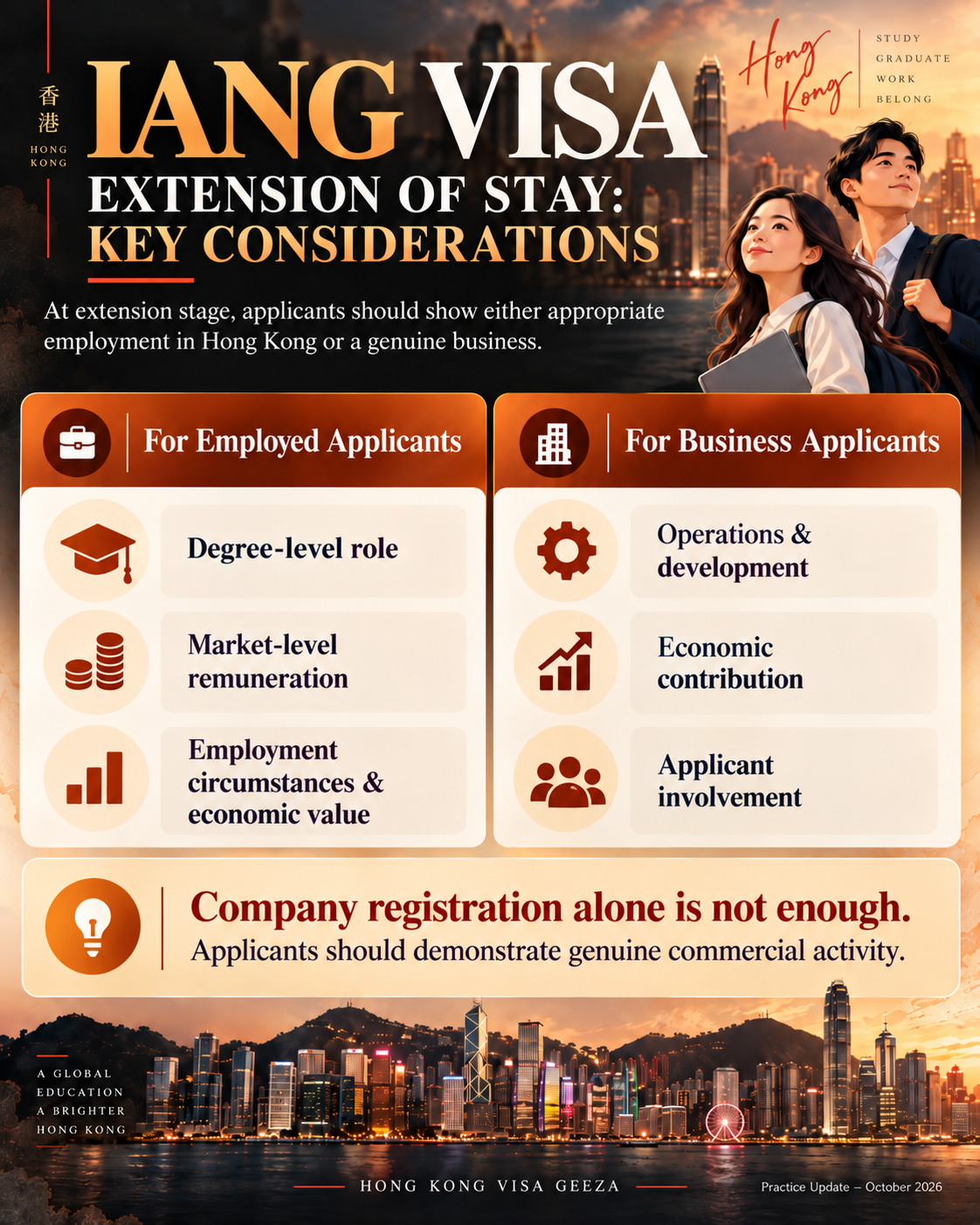
11

Oct 2026

The Twists And Turns Of An Unusual Hong Kong Permanent Residency Application

Posted by / in Case Study, Investment Visas, Long Stay & PR / 10 responses

Although this case study is based on a situation I was asked to provide guidance to many years ago, its content is still relevant today.

 Hong Kong Permanent Residency

Our client was a French national with a wife and 5 year old daughter – all of them, French citizens.

He had first arrived in Hong Kong in 2004 as a student to undertake an MBA programme at the University of Hong Kong.

Upon graduation in 2006, he joined a European investment bank where he worked continuously until 2010 when he was made redundant as part of the banking challenges associated with the GFC.

At the time he instructed us, he had an employment visa sponsored by his ex-employing investment bank with a 2 year period of stay endorsed inside his passport, taking him up just short of the complete 7 year time frame for the purposes of an application for the Right of Abode.

In 2010, with the chances of him gaining further employment in the investment banking game unlikely in the near term, our client decided to start a French wine importing business – but did not apply for an adjustment in his immigration status to allow him to be able to do this. He really needed an investment visa but had never bothered to get one.

As the period of stay availed by the investment bank expired 6 weeks before he would have been continuously resident for the 7 years needed for a Right of Abode application, he decided that he would take him family out of Hong Kong at the time his employment visa expired and bring them all back in as visitors, gaining a 90 day period of stay when they entered, waited six weeks, then submitted an application for the Right of Abode.

This was in 2011, 2 weeks before he asked for our help.

At the time of his application, he didn’t realise that you can’t apply for the Right of Abode if you have a visitor visa.

You need to be ‘resident’ at the time you apply. Instead he and his family were ‘visiting’.

The Hong Kong Immigration Department knocked back his application for permanent residency on this ground and so he found his way to us.

The key issues in this application were:

1 – the fact of his visitor visa status at the time he applied for the Right of Abode.

2 – the 11 months he had been working his French wine import business, unapproved by the Hong Kong Immigration authorities.

3 – as a prior student from HKU he could take advantage as a ‘returning graduate‘ and be afforded ‘positive consideration’ for any application that he might make in order to take up a new job in Hong Kong (for which he’d need an offer of employment from a suitably qualified sponsor).

Coincidentally, just after our client approached us for advice, an ex-colleague of his from the investment bank where he had worked for four years previously, asked him to come and consult on an energy project in the Philippines.

This ex-colleague had, three years prior, provided consulting services through his own, newly established one-man company and had turned over HKD10 million in consulting fees in the first 18 months. However, the project had come to a temporary halt, as these things often do, as certain government approvals processes played themselves out.

The project has been in a temporary hiatus but had, just recently, been reactivated in light of the Philippines government providing whatever consents had been necessary for it to progress to the next phase.

Consequently, and somewhat out of the blue, our client received an offer of employment from his ex-colleague for him to assist him in the next phase of the energy project.

This was good news on the one hand, but on the other, the employing business was still very much a ‘brass plaque’ consulting concern which had been effectively dormant for the last 18 months.

On the plus side, it had a strong balance sheet and also had a receipt from the Hong Kong Inland Revenue for more than HKD1 million it had paid in profits tax the year before. It also had a formal notification from its sole client that the energy project was now recommencing and thus was manifestly ready to re-engage in providing services once more.

We advised our client that this could be a heaven sent opportunity for us to secure an employment visa for him (with dependent visas for his wife and daughter) relying on the relaxed application consideration criteria which the Hong Kong Immigration Department afford to non local graduates of Hong Kong Universities.

We did, on the other hand, counsel that as the sponsoring employer was pretty much still a shell of an operation, there would be some tussling with the Immigration Department to persuade them of its bona fides as a quality employment visa sponsor.

As expected, we locked horns with the Department about the quality of the sponsor and had several exchanges with them each time providing them with more information, proof of the good prospects for the business and the critical role our client was going to be playing in its operations.

Finally, we suggested to the HKID that they approve our client’s employment visa subject to Business Review at the end of 12 months, a not unusual proposition, but suitable in the circumstances. The Hong Kong Immigration Department agreed and our client and his family’s applications were duly approved subject to this condition.

As the strategy all along had been to provide our client with a residence visa for the purposes of his Right of Abode application, the fact of this Business Review was ultimately unimportant because it would only come into play if our client applied for an extension to his new employment visa 12 months down the road.

In fact, two months after this, their Right of Abode applications were approved and so Business Review was never an issue. The really good news is that this client is now providing consulting services to the energy project AND running his French wine importing business quite lawfully as a permanent resident.

VisaGeeza.Ai – Making Hong Kong Immigration A Lot Easier

Hong Kong Permanent Residency

VisaGeeza.Ai – 13 Years In The Making

Check Out VisaGeeza.Ai

All Our Know-How : All Our Experience : Fully Interactive

100% FREE!

More Stuff You Might Find Useful

Redundancy – The Process Pitfalls Of An Expiring Hong Kong Employment Visa

Is It Better To Apply For Your Visa Before Or After You Move To Hong Kong?

I’ve Lost My Job. What About My Employment Visa – Will I Get Kicked Out Of Hong Kong?

10 Must Have Resources For A Successful Hong Kong Permanent Residency Application

Will I Still Qualify For The Right Of Abode If I Worked Temporarily In Macau Yet Lived In Hong Kong For The Full 7 Years?

Please select the social network you want to share this page with:
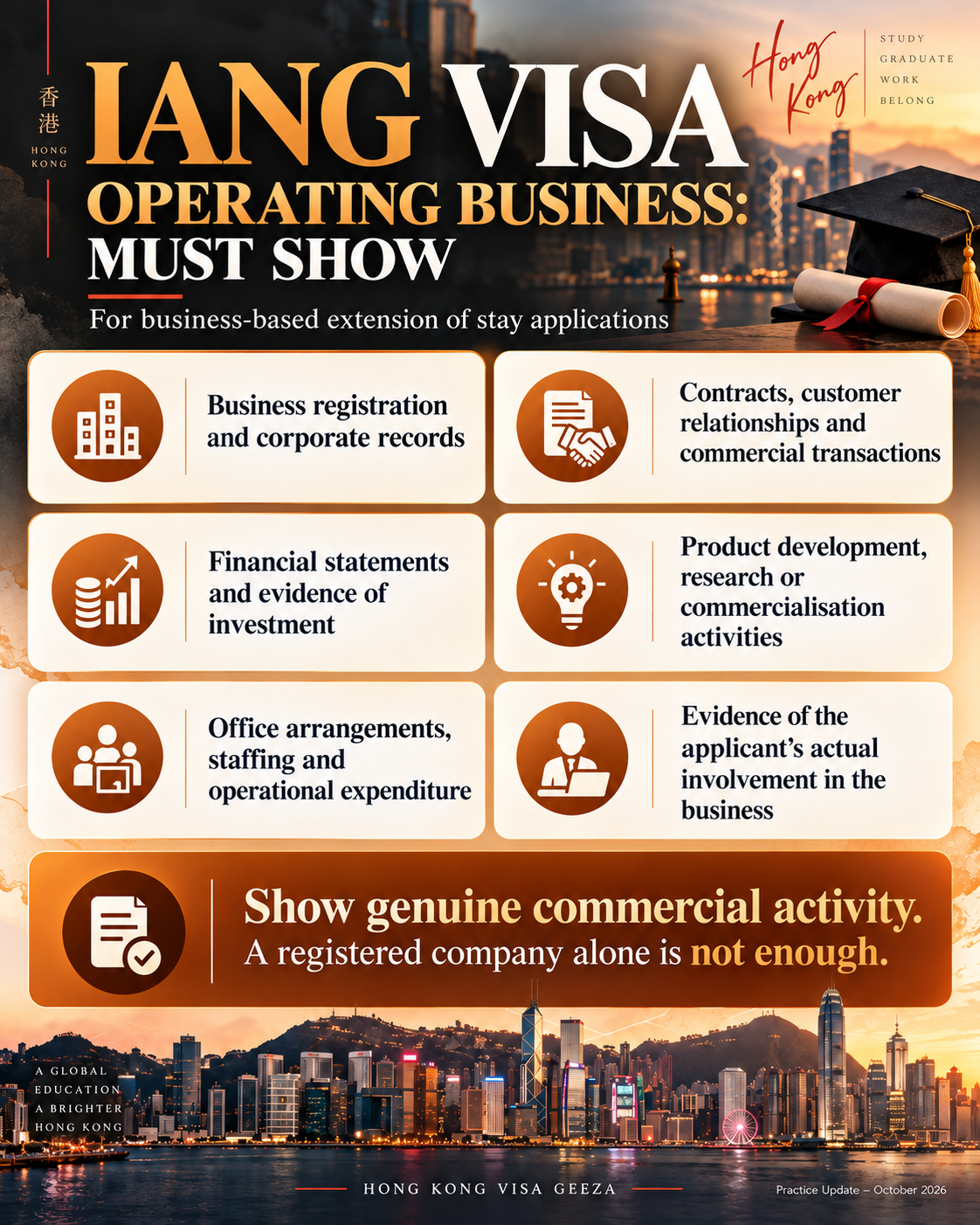
10

Oct 2026

What Are You Really Buying From A Hong Kong Immigration Consultant?

Posted by / in 60 Second Snapshot, Employment Visas, Family Visas, Investment Visas, Long Stay & PR, Refusals & Appeals, Special Programmes, Visitor Visas / 9 responses

What Do You Get For Your Money When You Instruct A Hong Kong Immigration Consultant?

First Published 2012 (15 Years Ago – Look How Young I Am!)

PRACTICE UPDATE OCTOBER 2026: How the content must now be read in light of current ImmD policy:

Look, if you head over to any expat forum or Reddit thread about visas in Hong Kong, you’ll see the keyboard warriors out in full force: “Why on earth would you pay a consultant thousands of dollars when ImmD gives you the forms for free?”

Fair question. And I’ve always given a straight answer: You can do it yourself. I’ve literally spent decades giving away the Hong Kong Visa Handbook, DIY guides, podcasts, and video explainers for free so anyone with the time, appetite, and stomach for it can do just that.

So what are people actually buying when they instruct an advisor?

Years ago, I used the analogy of my old Mazda 626. Could I service that car myself? Technically, yes. I had the brains, I could buy the spanners, and I could read the manual. But do I want to be under the hood, knuckles covered in grease, hoping I didn’t mess up the brake lines before driving into the Cross Harbour Tunnel in rush hour? Not on your life. I value spending that Saturday afternoon at my daughter’s concert.

What you are actually buying is peace of mind. You are paying to outsource the anxiety, the friction, and the headache of dealing with administrative limbo to someone whose day job is knowing how the Immigration Department thinks.

But Let’s Talk About Where We Are Now

If peace of mind was worth paying for back in 2012 or 2018, today it’s an entirely different ball game. ImmD’s playbook has undergone a massive structural overhaul since 2023, and that changes the calculus completely.

Here is the reality on the ground:

1. The Death of the “Tick-the-Box” Application

In the old days, if a decent company sponsored an employment visa and paid an acceptable wage, it was largely an administrative exercise. Today? ImmD case officers are forensic.

– They are dissecting corporate substance: real turnover, audited accounts, genuine commercial footprints, and whether you’re trying to sneak by with a serviced office or a shell.

– The local market testing requirement—proving why a Hong Kong permanent resident cannot do the job—is no longer a pro-forma paragraph.

– If you hand them a loose, amateur narrative, they won’t just ask for more papers; they’ll build a file that leads straight to a refusal.

2. The Great Scheme Mirage & The Extension Cliff

Everyone cheered when schemes like the Top Talent Pass (TTPS) rolled out and tens of thousands walked through the front door with frictionless initial approvals. But what many fail to see until it’s too late is the extension cliff.

ImmD does not hand out renewals just because you hold the initial visa. When extension time hits, you have to prove genuine local employment at market compensation or demonstrable, viable business operations with tax contributions. If you haven’t strategised your stay from day one, you are walking straight into a trap that can derail your entire 7-year countdown to Right of Abode.

3. Refusals Leave Scars

An ImmD refusal isn’t just a minor setback where you shrug and try again next week. It creates an indelible record on your immigration file. Once you are stamped with a refusal, any subsequent reconsideration or new application has to overcome an uphill battle of institutional skepticism.

The Real Takeaway

When I wrote that article, I said you were paying for an expert to do the strategic thinking and keep you out of the ImmD waiting rooms.

Today, with the department’s heightened scrutiny, you aren’t just buying convenience—you’re buying an insurance policy against catastrophic error. You’re paying for an advocate who knows how to structure the argument, stress-test the corporate sponsor, and protect your long-term pathway to PR before a single piece of paper lands on an Immigration Officer’s desk.

If your case is simple and you have the stomach for it, by all means, use the DIY resources and have a go yourself. But if you have skin in the game, an employer counting on you, or a business to build, getting an expert in your corner is the cheapest peace of mind you’ll ever buy.

Should You Pay or Shouldn’t You Pay?

Do you need a Hong Kong Immigration Consultant? There is sooooo much chatter on public forums about the value that a Hong Kong immigration consultant can add to the overall process of securing residency in Hong Kong. What the majority of these people fail to appreciate is the very simple reason why the Hong Kong immigration services profession is thriving, with customers spoilt for choice as to who to instruct.

Watch the short video above to understand why people are more than happy to spend their hard-earned money on professional visa assistance.

The Value of a Hong Kong Immigration Consultant: Peace of Mind

Two Types Of Customers

There is an ongoing debate among foreign participants on public internet forums about the value that Hong Kong immigration consultants add to the visa process. Some question why one would pay another person their hard-earned money to manage a process that they can easily undertake themselves. While this is a fair question, it deserves an equally fair response.

1: Those Who Don’t Want To Pay

The role of an immigration consultant is to provide a service. Consider a scenario where you have the necessary intellectual knowledge and skills to service your car yourself. You have the time, knowledge of where to buy replacement parts, and even the tools required for the job. However, you choose not to take on this task yourself and prefer to let someone else do it for you. Why is that? The answer is peace of mind.

2: Those Who Do Want To Pay

As a white-collar worker, I prefer not to get my hands dirty and would rather spend my time attending my daughter’s concerts than being under the hood of my car. One of the main reasons I choose not to service my car myself is peace of mind. I recall a time when my beloved but now long-deceased Mazda 626 ran out of petrol on the way to the Cross Harbour tunnel in Causeway Bay during rush hour. It was a scary and stressful experience.

Buying Peace of Mind

These days, I choose not to service my car myself because I value the peace of mind that comes with entrusting that task to a professional. Similarly, clients pay immigration consultants for the same reason – peace of mind. Besides the benefit of having an expert handle critical strategic thinking and analysis on their behalf, clients also appreciate the consultant’s ability to navigate the complexities of running and waiting around at the Hong Kong Immigration Department.

The value of an experienced Hong Kong visa immigration consultant goes beyond just efficiency and expertise. Clients are paying for peace of mind, knowing that their visa application is in capable hands. For those who prefer to handle their visa application themselves, that is perfectly fine. The Hong Kong Visa Handbook, this Hong Kong Visa Geeza Blog and the Hong Kong Visa Sherpa websites have all been created to provide valuable information and support for individuals who choose this route.

And Now, VisaGeeza.Ai Too

Last Words …

In conclusion, the value of engaging a Hong Kong immigration consultant extends beyond the practicalities of the visa process. It offers peace of mind, expert guidance, and the assurance that critical aspects of the application are being handled professionally. Whether you choose to seek professional help or go it alone, we hope that you find value in the resources available to you.


 Hong Kong Immigration Consultant

VisaGeeza.Ai – 13 Years In The Making

Check Out VisaGeeza.Ai

All Our Know-How: All Our Experience: Fully Interactive

100% FREE!


More Stuff You May Find Useful or Interesting

The Industry Secret Most Hong Kong Immigration Consultants Donlt Want You To Discover

100% Hong Kong Visa Application Success Rate? Take It All With A Pinch Of Salt!

Do Immigration Consultants Add Any Value To The Hong Kong Visa And Immigration Process?

Social Media Keeping Hong Kong Immigration Consultants On Their Toes – Scary Stuff!

Why Pay For Professional Help In Your Hong Kong QMAS Application When You Really Can Do It All By Yourself

Please select the social network you want to share this page with:
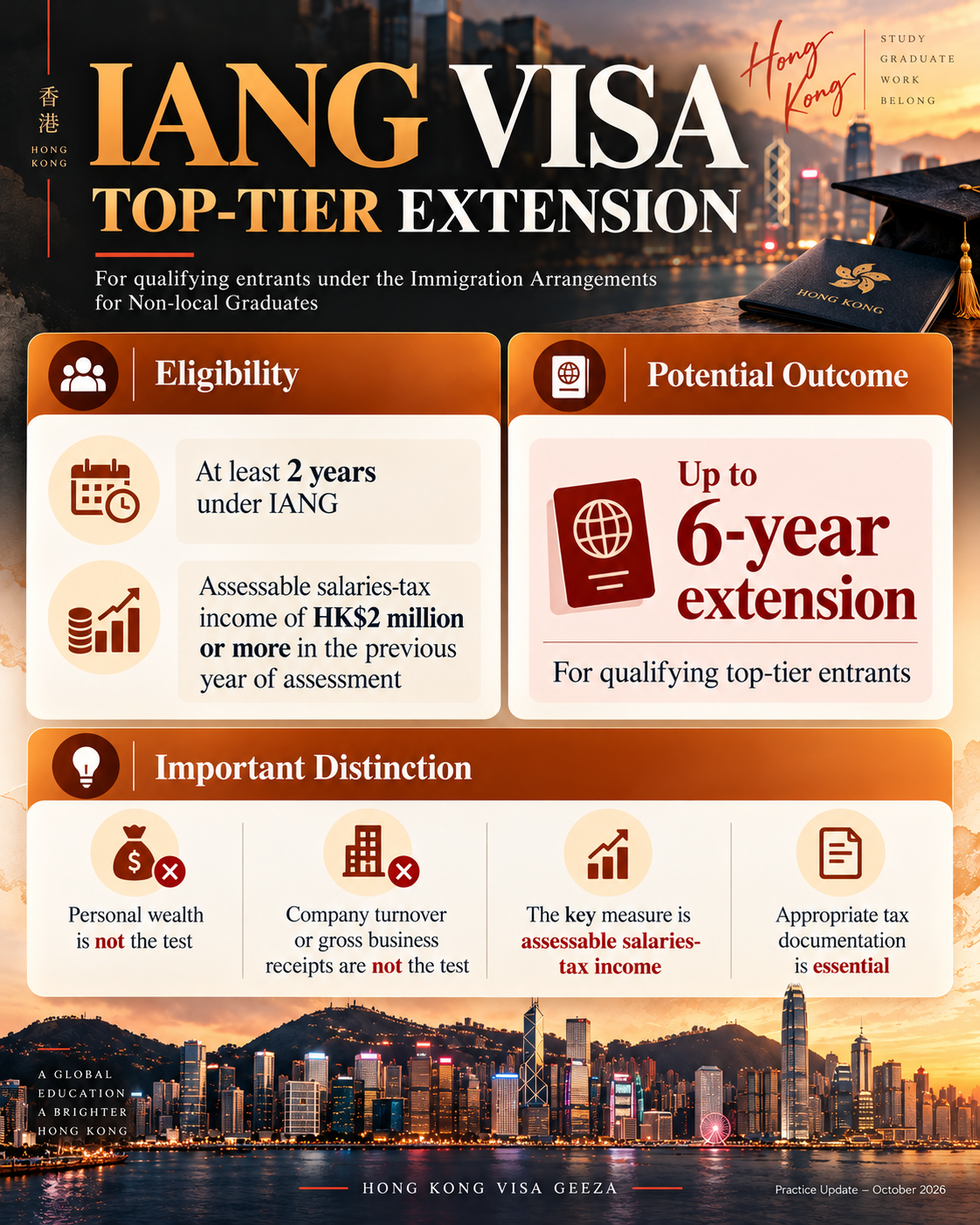
09

Oct 2026

Considerably Heightened Diligence by ImmD on All Types of Hong Kong Visa Applications

Posted by / in Employment Visas, Family Visas, Investment Visas, Long Stay & PR, Musing, Refusals & Appeals, Sherpa, Visitor Visas / 2 responses

Updated October 12, 2026.


Heightened ImmD Scrutiny

ImmD shifted from a traditional “process and approve” paradigm to an aggressive compliance-and-audit model. This heightened diligence has been driven by several key factors:

1. Abuse of New Talent Schemes: Massive application volumes under the Top Talent Pass Scheme (TTPS) and QMAS led to illicit intermediaries selling “empty shell” company sponsorships, fake employment contracts, and bogus qualifying credentials.

2. Post-National Security Law & Cross-Agency Scrutiny:  ImmD works in closer coordination with the Inland Revenue Department (IRD), Companies Registry, and Law Enforcement to cross-reference reported wages, company operations, and tax filings.

3. Shift from “Easy Entry” to “Strict Renewal: While entry criteria for schemes like TTPS were made frictionless, ImmD moved its primary enforcement bottleneck to the first extension (renewal), applying strict scrutiny to prevent “dormant” visa holders.

Heightened Diligence Across Visa Types

General Employment Policy (GEP) & AMTP

Substance Over Form for Sponsoring Employers: ImmD scrutinizes sponsoring entities far more aggressively. New, small, or startup sponsors are routinely hit with detailed questionnaires demanding:

1. Commercial lease agreements (virtual offices or shared flex desks without dedicated physical presence are heavily questioned or rejected).
2. Audited financial statements, recent profits tax returns, and bank statements showing verifiable operating cash flow.
3. MPF (Mandatory Provident Fund) contribution records proving current local staff counts.
4. Authenticity of the Role & Local Market Test: ImmD scrutinizes whether the job cannot genuinely be filled by local talent, probing role descriptions that appear reverse-engineered to fit a specific foreign candidate.
5. Criminal Record Declarations: Following high-profile controversies, ImmD introduced mandatory criminal conviction declarations across employment and talent entry categories.

Business Investment / Entrepreneur Visa

Substantial Economic Contribution: Gone are the days when an aspirational business plan and modest seed funding sufficed. ImmD requires clear evidence of actual execution:

1. Physical premises under lease.
2. Proof of committed capital deposited into a Hong Kong corporate bank account.
3. Direct job creation for local Hong Kong permanent residents (MPF records required).

Two-Year Extension Audits: Renewals are no longer routine administrative formalities. ImmD assesses actual performance against original business plans. Failure to generate projected turnover, sustain local employment, or establish viable operations leads to short extensions (e.g., 6–12 months on strict conditions) or refusal.

 Top Talent Pass Scheme (TTPS) — The Renewal Bottleneck

Income Verification (Category A): ImmD requires official tax assessments (such as official Inland Revenue notices or state tax returns) rather than private company payroll slips or self-generated dividend declarations.

Category B & C Degree Audits: Heightened credential verification requires primary-source validation (e.g., direct verification channels like CHSI/Parchment) to weed out counterfeit qualifications.

Extension Diligence: At renewal, TTPS holders must prove they are in genuine, market-rate employment commensurate with degree level, or that they have established an active business with genuine turnover and local staff. Holding a shell company or receiving a token stipend results in non-renewal.

Dependant Visas

Bona Fide Relationship Checks: Spousal applications—particularly where the sponsor is a recent immigrant, permanent resident, or where there is a large age disparity—face intensive evidentiary burdens (joint leases, joint bank accounts, photographic and travel timelines).

Adequate Financial Maintenance: Sponsors must provide tax receipts, pay slips, and housing proof showing they can support dependants at a standard of living well above the subsistence level without recourse to public assistance.

 Capital Investment Entrant Scheme (New CIES)

Pre-requisite Net Asset Audits: ImmD and InvestHK enforce strict rules requiring applicants to provide Certified Public Accountant (Practicing) audit reports proving continuous net assets of at least HK$30 million for the entire 24 months preceding the application.

Strict Asset Portfolio Monitoring: Ring-fenced assets are subject to stringent oversight with authorized financial intermediaries; unauthorized transfers or failure to maintain asset levels trigger immediate review.

Permanent Residency (Right of Abode – 7-Year Rule)

The “Ordinary Residence” Test: ImmD reviews prolonged absences from Hong Kong (customarily any single absence exceeding 180 days). Applicants must submit extensive documentation proving Hong Kong remained their primary home:

1. Maintenance of a continuous residential address (tenancy contracts/utility bills).
2. Local tax filings covering the full seven-year window.
3. Physical presence of immediate family members in Hong Kong.
4. Evidence that extended overseas stays were on explicit employer assignment with salary paid locally.

VisaGeeza.Ai – Making Hong Kong Immigration A Lot Easier

Hong Kong Permanent Residency

VisaGeeza.Ai – 13 Years In The Making

Check Out VisaGeeza.Ai

All Our Know-How : All Our Experience : Fully Interactive

100% FREE!

More Stuff You May Find Useful or Interesting

Is there such an animal as a ‘flexible working visa’ for Hong Kong?

How to get a Hong Kong employment visa automatically with no questions asked!

The long stay visitor’s awkward predicament

How a Hong Kong employment visa application can go completely wrong if you don’t know what you’re doing!

Getting a working visa for Hong Kong is just a matter of filling in the forms, right?

Please select the social network you want to share this page with:
08

Oct 2026

PRACTICE UPDATE: A Major Strategic Shift: The Upgraded Assessment Regime for Hong Kong’s Investment as Entrepreneur Visa

Posted by / in Investment Visas, Musing, Practice Update, VG Front Page / No responses

A Major Strategic Shift: The Upgraded Assessment Regime for Hong Kong’s Investment as Entrepreneur Visa

Over the past three and a half decades of advising on Hong Kong immigration jurisprudence and administrative practice, our firm has observed numerous regulatory cycles, administrative refinements, and policy calibrations. Across that thirty-five-year continuum, the Immigration Department (ImmD) has routinely adjusted its scrutiny to match broader macro-economic priorities. However, the comprehensive policy overhaul codified and systematically enforced since April 2026 marks what is undeniably the most consequential, structural upgrade to the General Employment Policy (GEP) – Investment as Entrepreneur framework in modern history.

For prospective founders, international investors, and corporate executives evaluating commercial ventures in the territory, the threshold of eligibility has ceased to evaluate prospective economic intent. In its place stands an exacting assessment regime founded upon immediate, verifiable, and institutional-grade operational substance.

The TTPS Category A Benchmark: Redefining Entrepreneurial Substance For Approval


To understand the departmental mechanics driving this policy shift, one must examine ImmD’s broader economic talent strategy. Following several years of expansive talent acquisition through special visa mechanisms, the administration has pivoted toward quality, domestic economic integration, and measurable fiscal yield.

Historically, the GEP Entrepreneur route accommodated early-stage founders who incorporated a standard private  limited company, submitted a well-researched two-year business projection, leased a serviced office or flexible co-working facility, and obtained initial entry clearance based on prospective expansion. ImmD case officers routinely took a measured commercial view, giving viable founders runway to prove their concept locally.

That discretionary leniency has ended. Today, ImmD has effectively aligned its internal assessment standards with the economic substance benchmark codified under Category A of the Top Talent Pass Scheme (TTPS).

Under the TTPS Category A rubric, applicants qualify on the basis of generating taxable enterprise income exceeding HKD 2.5 million derived from 100% self-owned, operating commercial enterprises. ImmD now utilizes that operational scale and financial baseline as an administrative proxy for what constitutes genuine entrepreneurial viability in Hong Kong. In the eyes of adjudicating officers, a business generating that tier of verifiable commercial activity represents the baseline profile of an entrepreneur capable of making a “substantial contribution to the economy of Hong Kong.”

The operational consequences of this alignment are profound:

  • Targeted Institutional Profiles: The framework is specifically engineered to accommodate mature commercial operators possessing demonstrable track records, established market demand, and substantial risk capital.
  • The Elimination of the “Employee-to-Founder” Transition: First-time entrepreneurs—most notably foreign professionals currently residing in Hong Kong on standard GEP employment visas seeking an in-country “change of visa category”—face an exceptionally steep barrier. The longstanding tradition of mid-career corporate executives resigning from sponsored employment to launch boutique advisory firms, consultancies, or asset-light ventures on modest startup capital is no longer viable. Applications lacking immediate, substantial capital deployment and institutional footprint are receiving immediate administrative pushback and summary requisitions.

What It Now Takes To Get Approved

While statutory provisions under the Immigration Ordinance remain formally unchanged, administrative practice has hardened across every primary assessment metric. Analysis of recent approvals and requisitions handled by our practice demonstrates that case officers now expect tangible economic infrastructure to be fully operational prior to final visa endorsement.

 1. Immediate Capital Deployment (HKD 1.5M to 2M Deployed)

Pledges of future capital injections, nominal issued share capital, or offshore bank statements demonstrating personal liquidity are no longer accepted as proof of capability. Adjudicating officers require unencumbered capital—typically between HKD 1.5 million and HKD 2 million—to be fully remitted into a functional Hong Kong corporate banking facility. Furthermore, applicants must document actual operational expenditure drawn from these funds (e.g., fit-out costs, deposits, retained service providers, technology infrastructure) alongside verifiable cash reserves sufficient to sustain operations for the initial visa term.

2. Immediate Local Job Creation (2 to 3 Roles Operational)

The departmental expectation has shifted from future recruitment promises to immediate local employment. Case officers no longer treat local hiring as an aspirational milestone dependent on downstream profitability. Approvals now consistently require 2 to 3 full-time local Hong Kong permanent residents to be formally contracted, actively drawing market-rate salaries, and enrolled in Mandatory Provident Fund (MPF) contribution schemes prior to the finalization of the application. Models relying on offshore outsourcing or remote contractor arrangements face formal inquiries regarding why the entity requires an on-the-ground presence in Hong Kong.

3. Dedicated Physical Commercial Substance (“Four Walls”)

The era of launching an eligible Hong Kong venture from a flexible co-working desk, hot-desking facility, or serviced address without physical demarcation has effectively drawn to a close. ImmD requires tangible commercial substance: an executed commercial lease granting exclusive physical possession—verifiable “four walls”—commensurate with the proposed industry and scale of operations. Officers frequently request floor plans, lease instruments, photographic evidence of signage, and commercial utility records to confirm that the space is not shared or temporary.

4. Expanded Multi-Year Growth Trajectories

Business projections submitted to the department must cover an expanded three-year operational horizon backed by defensible unit economics. The business plan must articulate sustainable, incremental additions to the local workforce across Years 2 and 3. ImmD expects the enterprise to function as an active employer of local talent rather than a closed-loop owner-operator vehicle.

5. Verifiable Integration with Local Commercial Ecosystems

Case officers conduct detailed forensic evaluations of the applicant’s domestic business network. ImmD expects to see executed vendor contracts, operational relationships with domestic financial institutions, local client retainers, and integrated domestic supply chain logistics. Commercial entities configured purely as brass-plate conduits for cross-border offshore invoicing without domestic operational roots are subject to rigorous scrutiny.

Strategic Guidance for Prospective Applicants

Hong Kong continues to maintain its historical advantages as an international financial centre, offering low corporate tax rates, common law stability, and strategic access to regional markets. The jurisdiction remains receptive to foreign direct investment and high-caliber commercial enterprise. What the administrative apparatus has definitively eliminated, however, is accommodation for under-capitalized, highly speculative, or lifestyle ventures.

For enterprise founders seeking to establish eligibility under the GEP Investment regime, several strategic measures should guide preparation:

  • Pre-Fund the Hong Kong Entity: Establish an active corporate banking relationship and execute necessary equity transfers well ahead of submission. The presence of cleared, deployed capital is non-negotiable.
  • Formalize Local Employment Structures: Identify and contract qualified local personnel early. Ensure complete regulatory compliance across Employment Ordinance contracts, MPF enrollment, and statutory employee compensation insurance.
  • Secure Dedicated Tenancy: Factor commercial leasing costs directly into the initial capitalization model, bypassing serviced memberships in favor of private commercial space.
  • Evaluate Government-Supported Startup Alternatives: For early-stage technology founders who lack the capital reserves to satisfy the GEP standard directly, designated government-backed incubation schemes—specifically those administered by Cyberport or the Hong Kong Science and Technology Parks Corporation (HKSTP)—remain a viable strategic path. Ventures endorsed by these recognized programs continue to benefit from expedited departmental review under distinct, tailored facilitation policies.

The assessment regime for Hong Kong’s Entrepreneur visa has transformed fundamentally. Founders must structure their applications not as aspirational proposals, but as fully mobilized, institutional enterprises ready for departmental audit from day one.

More Stuff You May Find Useful or Interesting

Successfully Apply For An Entrepreneur Visa In Hong Kong

How to read in light of current ImmD policy:

Historically, as published by the Hong Kong Visa Geeza in How to Successfully Apply For an Entrepreneur Visa in Hong Kong, this foundational blueprint advised foreign founders that establishing an approvable business under the General Employment Policy (GEP) rested on qualitative credibility, narrative clarity, and commercial intent. Under the prevailing discretionary paradigm, the Immigration Department evaluated applications holistically. An articulate applicant could satisfy the statutory “substantial contribution” test by committing modest seed capital of a few hundred thousand Hong Kong dollars to fund early runway, securing an affordable desk in a serviced office or co-working space, and submitting a standard two-year business projection that promised to hire local staff incrementally over a phased ramp-up period as trading developed.

Under the upgraded post-April 2026 administrative regime aligned with Top Talent Pass Scheme (TTPS) Category A operational substance, ImmD has discarded speculative two-year runway forecasts and aspirational recruitment promises in favour of an immediate, binary hardware audit. Un-incubated applicants can no longer rely on narrative business models or asset-light launch plans. Adjudicating officers now mandate the upfront deployment of HKD 1.5 million to HKD 2.0 million in unencumbered corporate liquidity held in a local Hong Kong business bank account, an executed commercial tenancy for exclusive premises with dedicated “four walls” (expressly disqualifying co-working suites and serviced desks), active MPF payroll contributions for two to three full-time local Hong Kong permanent resident employees operating on-site from inception, and a defensible three-year business projection rooted in verified domestic unit economics. Lacking this deployed physical and financial hardware on day one results in swift, summary refusal.

Hong Kong Entrepreneur Visa Application Guide In A Nutshell

How to read in light of current ImmD policy:

Historically, as published by the Hong Kong Visa Geeza in Hong Kong Entrepreneur Visa Application Guide In A Nutshell, this practical procedural summary reassured prospective founders that there was no explicit statutory financial minimum required to secure an Investment as Entrepreneur visa. The advice instructed applicants that capitalization simply needed to be sufficient to cover the initial launch and the first two quarters of operating runway. ImmD case officers exercised broad, holistic discretion, permitting lean founders to conserve working capital, operate flexibly from shared incubators or serviced business suites, and outline a high-level two-year operational roadmap where local hiring remained an aspirational downstream milestone tied to future profitability.

Under the current administrative practice, the assertion that there is no explicit financial threshold has been rendered completely obsolete by the departmental adoption of the TTPS Category A fiscal baseline (benchmarked against an enterprise capacity of HKD 2.5 million). ImmD has eliminated qualitative leniency for un-incubated applicants: capitalizing merely two quarters of operational expenses is summarily rejected as underfunded. Founders must now demonstrate fully realized, deployed liquidity of HKD 1.5 million to HKD 2.0 million deposited into a functional Hong Kong corporate banking facility, an exclusive commercial tenancy agreement for dedicated private premises, and immediate payroll registration with active MPF contributions for two to three local permanent resident staff. Without this enterprise-grade hardware firmly established prior to visa endorsement, independent applications face guaranteed refusal.

Hong Kong Investment Visa – The 3 Legs of the Application Approvability Stool

How to read in light of current ImmD policy:

Historically, as published by the Hong Kong Visa Geeza in Hong Kong Investment Visa – The 3 Legs of the Application Approvability Stool, the approvability architecture was explained as an interdependent, three-legged stool comprising capital investment, local job creation, and substantial economic contribution. In that era, the three elements were assessed flexibly and qualitatively in the round. A founder who was light on upfront capital could successfully offset that deficit by bringing high-concept professional expertise, proprietary intellectual property, or specialized trade connections, while committing to create local jobs over a phased two- to three-year ramp-up period from an agile, serviced office base.

Under the post-April 2026 enforcement framework, the flexible three-legged stool has hardened into an unbending, pre-conditioned hardware audit where each prong must be fully operational on day one. ImmD no longer permits applicants to balance weak capital deployment with impressive personal resumes or asset-light consulting models. The capital leg requires HKD 1.5 million to HKD 2.0 million in cleared, unencumbered liquidity deposited into a local commercial bank account; the job creation leg requires two to three full-time local permanent residents already enrolled in statutory MPF schemes and drawing market-rate salaries; and the economic contribution leg demands an executed, dedicated commercial tenancy (“four walls”) integrated into the local supply chain. Failure to satisfy every single leg with verified, physical hardware results in immediate application failure.

How To Get A Hong Kong Entrepreneur Visa (The Catch-22)

How to read in light of current ImmD policy:

Historically, as published by the Hong Kong Visa Geeza in How To Get A Hong Kong Entrepreneur Visa (The Catch-22), this strategic guidance tackled the classic immigration dilemma: how an entrepreneur can take the preparatory steps necessary to establish a business without unlawfully working on a visitor visa or breaching prior employment conditions of stay. The Geeza historically advised applicants to lodge their investment application right at the threshold of inception, using proposed business plans, preliminary incorporations, and conditional commitments to secure approval before substantive commercial trading commenced, thereby navigating the Catch-22 safely and lawfully within ImmD’s discretionary latitude.

Under modern adjudication standards, filing an early-stage, aspirational proposal at inception is an immediate recipe for summary refusal. ImmD now strictly refuses to approve un-incubated business plans that lack deployed operational reality, creating a severe operational paradox for foreign founders. Because case officers demand verified hardware on day one—including an executed commercial lease, HKD 1.5 million to HKD 2.0 million in local corporate liquidity, and active local payroll with MPF contributions—founders cannot establish these facts in-country as visitors without risking prosecution for unlawful employment under Section 41 of the Immigration Ordinance. This regulatory trap can now only be bridged either by mobilizing institutional-scale corporate infrastructure remotely through authorized local nominees or by securing formal admission into an accredited government incubator (such as Cyberport or HKSTP), which remains the sole statutory safe harbor exempt from the day-one hardware audit

Hong Kong Investment Visa for an Unprofitable Company – Easy or Hard?

How to read in light of current ImmD policy:

Historically, as published by the Hong Kong Visa Geeza in How Easy (Or Hard) Is It For A Second Foreign National Business Partner To Get A Hong Kong Investment Visa For An Unprofitable Company?, this case analysis evaluated whether a foreign partner could secure an entrepreneur visa to join an existing Hong Kong corporate entity that had not yet achieved profitability. Historically, ImmD evaluated such applications through holistic commercial discretion. If the applicant could demonstrate that their joining would inject fresh working capital, introduce valuable domain expertise, or implement a turnaround plan that would steer the business toward profitability and phased job creation over the subsequent two years, case officers were willing to grant approval despite historical trading losses.

Under the contemporary assessment regime, attempting to sponsor an incoming foreign entrepreneur into an unprofitable, un-incubated business based on prospective turnaround narratives is essentially futile. Aligned with TTPS Category A financial benchmarks, ImmD treats ongoing unprofitability as a red flag indicating a lack of commercial viability. Case officers will summarily reject the application unless the sponsoring entity can independently prove that it already possesses enterprise-scale stability: an active, exclusive commercial office tenancy, two to three local permanent resident employees continuously maintained on full-time MPF payroll, and unencumbered corporate liquidity of at least HKD 1.5 million to HKD 2.0 million dedicated to sustaining the business without relying on speculative future cash flows. Outside accredited incubation programs, narrative rescue plans are disregarded; the hardware must be fully deployed and verifiable.


VisaGeeza.Ai – Making Hong Kong Immigration A Lot Easier

Upgraded Assessment Regime for Hong Kong’s Investment as Entrepreneur Visa

VisaGeeza.Ai – 13 Years In The Making

Check Out VisaGeeza.Ai

All Our Know-How : All Our Experience : Fully Interactive

100% FREE!

Please select the social network you want to share this page with: